David Solet makes his case for the Middlesex DA
(9-minute read)
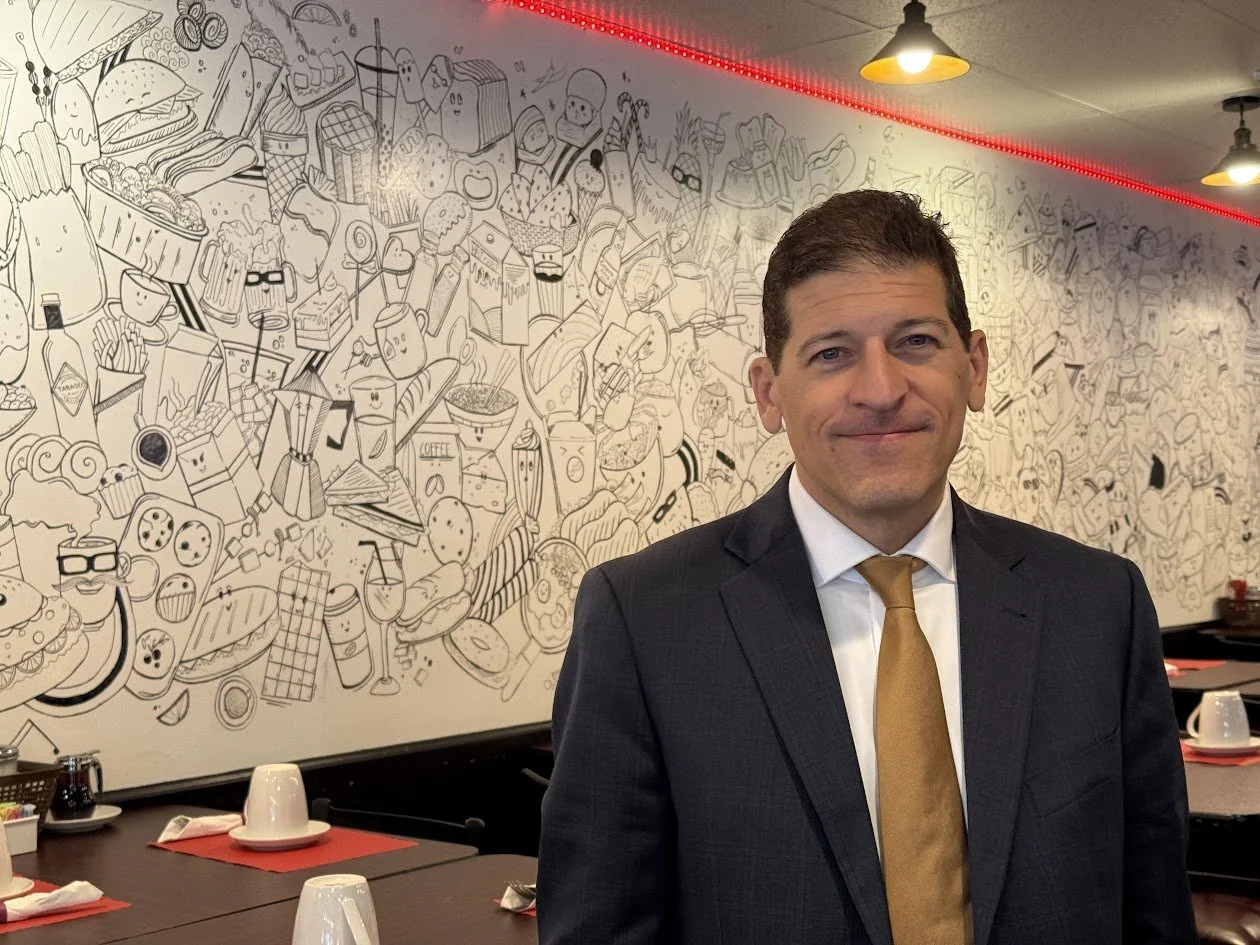
David Solet at Half & Half in Reading, where he sat down for breakfast and an interview. Photo by Taylor Gregory.
Over breakfast and coffee at Half & Half in Reading on Thursday, July 30, David Solet made his pitch for why he should be the next Middlesex County District Attorney. After the interview wrapped up, he stayed to talk with a few curious patrons who had questions for the candidate, as the breakfast crowd flowed and the kitchen stayed busy.
Solet is challenging incumbent Marian Ryan in the Democratic primary for Middlesex County District Attorney, with the state primary set for September 1. He spent more than two decades as a prosecutor in the Middlesex District Attorney’s office, from 2001 to 2025, before resigning over what he describes as professional differences with the office’s leadership. More on his campaign is available on his website.
The conversation ranged from his priorities, his approach to alternatives to incarceration, questions of accountability and transparency, and his case for change against the incumbent. A theme ran through his answers: his view that the district attorney’s job is both to use the laws already on the books and to speak up when those laws fall short. Ryan was not part of this interview, and this profile reflects Solet’s account of the race and the office.
Setting the agenda
Solet said his top priorities would be gun violence, and specifically the trafficking of firearms into Massachusetts. Because the state has strict firearm regulations, he said, most guns used in crimes here come from out of state, and he pointed to Maine, New Hampshire, Georgia, and Florida as the leading sources. Police in Middlesex County recover well over 100 illegal firearms each year, he said, but in his view the office has not done the sustained investigative work needed to trace those guns to their sources and prosecute the networks that supply them. He pointed to a 2014 state firearms trafficking statute that he said has produced only a handful of convictions in five years, and he proposed creating a dedicated crime gun unit to pursue those cases.
A second priority, he said, is closing the gap in existing law and being willing to advocate publicly when the law is failing people. He focused on dangerousness hearings, the process by which prosecutors can ask a court to detain a defendant before trial. A 2019 state Supreme Judicial Court decision struck down part of that statute on the grounds that it was too vaguely drafted, which Solet said removed the ability to seek such hearings for a set of serious crimes, including armed robbery, bomb-making, and aggravated rape of a child. He said he drafted legislation to close that gap while serving as chief legal counsel to the Secretary of Public Safety, that then-Governor Charlie Baker filed and championed it, and that it did not pass. He faulted the incumbent for not publicly advocating for the change.
To illustrate the stakes, Solet cited a 2024 case that drew significant news coverage, in which a man indicted on child rape charges was released before trial and later killed the child he was accused of assaulting before taking his own life. He argued the case shows why the loophole should be closed.
He raised similar concerns about impaired driving, arguing the state law has not kept pace with drug-impaired driving the way it has with drunk driving. He pointed to legislation named for State Police Trooper Thomas Clardy, who was killed by a driver with THC in his system, which he helped draft and which did not pass, and he said Massachusetts still lacks testing standards and license-suspension tools for drivers suspected of drug impairment.
Solet also emphasized that most of the office’s cases are not violent felonies and that most offenders are, in his words, amenable to rehabilitation. Community partnerships with mental health providers, substance abuse counselors, and programs that address anger and violence are essential tools, he said, and the district attorney should be a public voice for keeping those largely nonprofit programs funded.
Beyond incarceration
On diversion, Solet said there is a role for keeping some cases out of the court system, especially those involving juveniles and young adults charged with nonviolent offenses. But he cautioned against assuming that more diversion is always better. He drew a distinction between the probation-based outcomes common in district court and pre-arraignment diversion, which avoids creating an official record of entry. That absence of record, he argued, can make it harder in life to tell who is truly a first offender, which in turn complicates the leniency he believes genuine first offenders deserve. “It’s not the case that if diversion is good, more diversion is better,” he said.
For cases involving mental illness, addiction, or homelessness, Solet said prosecutors should always be weighing whether incarceration would accomplish anything, and should try to address root causes where doing so would benefit the community. At the same time, he said, some people facing those struggles also pose a serious public safety threat, and for them, incarceration may be necessary. He described prosecuting people who robbed stores with weapons to support heroin addictions, and said that while he is personally sympathetic to addiction, he could not excuse violence against others.
On mandatory minimum sentencing, Solet said Massachusetts has relatively little of it, noting that most felonies give judges broad discretion. He explained that even a serious charge like breaking and entering a home at night can result in anything from up to 20 years in prison down to probation. He said he supports mandatory minimums in some cases, as long as the minimum reflects the least serious version of the crime rather than a one-size-fits-all sentence, describing it as a floor rather than a standard. He said he is comfortable with that approach for offenses such as gun trafficking.
Accountability and oversight
Asked how he would handle police misconduct given that he has been endorsed by more than 30 police departments and related organizations, Solet said police are the district attorney’s essential partners in fighting crime, and that he is proud of those endorsements. But officers who commit crimes, he said, must be prosecuted like anyone else, and he said he has prosecuted law enforcement officers during his career. Public confidence in the justice system, he argued, depends on demonstrating integrity rather than claiming it. As he put it, “the ethical duty of a prosecutor is not to win; it is to do justice.”
On dangerousness hearings more broadly, Solet said they are especially important in Massachusetts because the state, unlike some others, does not allow cash bail to be used to protect the community from danger, only to address the flight risk. That makes dangerousness hearings the only tool for detaining a dangerous defendant, including many charged with violent crimes, who can be safely released with conditions, and that prosecutors should look carefully at what is known about each defendant before making that call.
For juveniles who could be charged in either the juvenile or adult system, Solet said the key factors he would weigh are the defendant’s age, with older teens closer to the line for the adult system, and the nature of the offense. Most juvenile cases belong in juvenile court, he said, but crimes such as a planned school shooting warrant serious consideration of whether the court is equipped to handle them. He noted that the juvenile court’s stated purpose is the best interest of the child, while adult court must balance that goal against community safety.
Throughout, Solet returned to transparency as a core value, arguing that a district attorney should do the right thing regardless of political pressure and speak out when laws are inadequate. He tied that theme to a recently enacted change to the state’s statute of limitations for rape cases. Governor Maura Healey signed that reform, which eliminates the time limit to prosecute rape when new DNA evidence identifies a suspect after the previous 15-year deadline, into law in July 2026 as part of the state budget. Solet said he had urged the office to champion the change earlier, based on a decades-old cold case he had solved, and that he was glad it ultimately became law.
His case against the incumbent
Much of Solet’s pitch rests on the argument that the office can do better, even in a county with low crime rates.
He acknowledged that Ryan points to Middlesex County’s violent and property crime rates, which are well below the national average, as evidence of the office’s success. Solet called that argument suspect, contending that crime rates are driven largely by demographic factors beyond the prosecutor’s control, such as the county’s affluence and education levels. Middlesex is among the most affluent communities in the country, he said, and argued that the real question is whether the office is doing its best. He pointed to recent violent incidents in Cambridge, where he lives, as evidence there is still work to do.
Solet, who led the office’s cold case unit, said he personally solved more than a dozen cold cases, including murder and stranger sexual assaults, and that the county still has more than 300 unsolved murders and roughly 70 unsolved stranger sexual assaults. He said he repeatedly asked for more resources and was turned down, and that the office increased the cold case unit from one prosecutor to two only after he resigned.
On recruiting and retaining attorneys, Solet argued the office loses talented young lawyers, particularly young women, because of a management style he described as micromanaging, with the incumbent insisting on control over high-value decisions. He said he would instead push responsibility down to team supervisors and their members, comparing a well-run office to a teaching hospital where experienced prosecutors develop the next generation. Because the office cannot match private-sector pay, he said, it has to offer purpose and professional growth, and micromanagement undercuts both.
Describing what he called a reset for the office, Solet said he would create a crime gun unit, give line prosecutors more responsibility for their own cases, and rebuild communication with local police departments. On immigration, he said the district attorney has no role in immigration enforcement, which is a matter of federal law, though state and federal authorities should cooperate and share information when appropriate. He said he would prosecute federal agents, including ICE agents, who commit crimes in Massachusetts, and he criticized federal enforcement aimed at nonviolent immigrants as a misuse of resources.
Middlesex County Democratic primary will be held September 1.
