Massachusetts Municipal Association annual conference draws local leaders to Connect 351
(8-10 minute read)
More than 1,000 municipal leaders from across the Commonwealth gathered January 22-24, 2026, in Boston’s Seaport District for the annual conference of the Massachusetts Municipal Association, known as Connect 351, a three-day event focused on policy, training, collaboration, and advocacy for cities and towns.
The conference brought together select board members, mayors, councilors, managers, clerks, finance officials, and department leaders to share best practices, attend workshops, and shape statewide municipal policy priorities for the year ahead - with strong participation from Reading’s municipal leadership team.
What is the Massachusetts Municipal Association?
The Massachusetts Municipal Association (MMA) is the professional trade association for municipal officials in Massachusetts. The organization is nonpartisan and serves as a policy expert, advocate, and connector for local government.
The MMA works to:
Articulate a clear and united municipal message
Develop and advocate for shared policy goals
Share information and best practices
Improve efficiency and effectiveness in municipal delivery
Through shared learning, shared ideas, and a coordinated voice on Beacon Hill, the MMA represents the collective interests of cities and towns statewide.
Connect 351: collaboration in action
Held at the Menino Convention and Exhibition Center, Connect 351 featured expanded networking opportunities and new interactive programming this year, including:
A Boardroom Breakout escape-room style leadership exercise
A Women Leading Government “Burning Questions” session
Affinity networking spaces
Expanded peer collaboration sessions
In reflections shared after the conference in an Executive Director’s Report, MMA Executive Director and CEO Adam Chapdelaine described the gathering as more than just an event.
“This conference isn’t just an event; it’s collaboration in action. From the Berkshires to the Cape and everywhere in between, leaders from cities and towns across the state came together to share solutions, tackle our toughest challenges, and envision a stronger Commonwealth.”
He emphasized that the conversations and partnerships formed at the conference are intended to continue back in local city and town halls across Massachusetts.
Keynote speakers and featured voices
The conference featured major state and national speakers addressing civic leadership, collaboration, and emerging challenges facing municipalities.
Features speakers included:
Governor Maura Healey and Lt. Governor Kim Driscoll - discussing state-local partnership priorities
Timothy Shriver, CEO of UNITE and co-creator of the Dignity Index - on constructive civic dialogue
Tami Pyfer, co-creator of the Dignity Index - speaking at the Women Elected Municipal Officials luncheon
Clarence Anthony, Executive Director of the National League of Cities - on partnerships, AI, and housing challenges
Chapdelaine specifically highlighted the impact of the Dignity Index presentations at the partnership with the National League of Cities, thanking both speakers and partner organizations for contributing practical leadership tools and perspectives.
Workshops and training
The conference included 17 workshops across multiple tracks, covering topics such as:
Crisis communications
Employee recruitment and retention
Artificial Intelligence in government
Health insurance cost pressures
Strategic leadership
Fiscal management
Accessibility and civility in public service
Municipal vehicle electrification
Many sessions were designed to provide immediately usable strategies for local officials and staff.
Trade Show and sponsors
A large municipal Trade Show featured more than 280 exhibitors showcasing products and services for local governments, from technology and cybersecurity to infrastructure and energy solutions.
Chapdelaine credited sponsors and exhibitors for helping deliver a high-quality conference experience. He noted that sponsor and exhibitor innovation helps municipalities modernize and operate more effectively.
Strong Reading participation
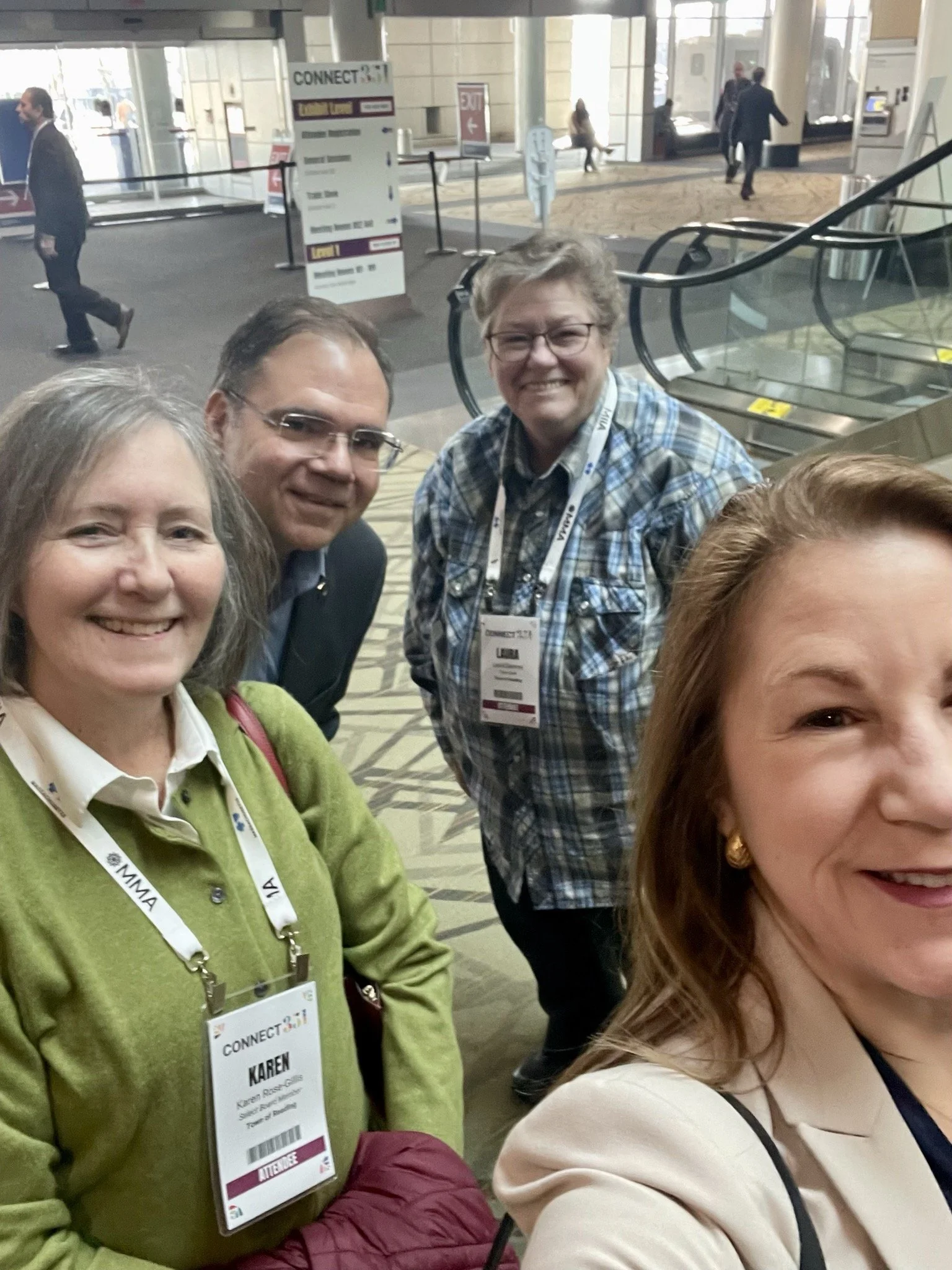
Members of the Reading Delegation at the MMA conference held January 22-24. Pictured (left to right): Select Board member Karen Rose-Gillis, Town Manager Matt Kraunelis, Town Clerk Laura Gemme, and Select Board member Karen Herrick. Photo provided by Karen Herrick.
Reading municipal leadership was well represented at the conference. Reading officials attended sessions across all three days, connecting with peers and experts on topics ranging from fiscal strategy and governance to accessibility and electrification.
Reading attendees included:
Select Board members Karen Rose-Gillis and Karen Herrick
Town Manager Matt Kraunelis
Town Clerk Laura Gemme
Herrick, who serves as a Women Elected Municipal Officials director and member of the MMA Fiscal Policy Committee, said the conference combined learning, sharing, and policy work leading up to the Annual Business Meeting.
Annual Business Meeting
The conference concluded with the MMA Annual Business Meeting on January 24, where municipal delegates voted on a major FY2027 Fiscal Partnership Resolution directed to state leaders.
The resolution, developed by MMA policy committees and approved by the MMA Board, calls for a strengthened fiscal partnership between state and local governments.
Core concerns identified
The resolution highlights mounting fiscal pressure on municipalities due to:
Heavy reliance on property taxes capped by Proposition 2 1/2
Rising costs outpacing allowable revenue growth
Expanding state and federal mandates
Charter school funding impacts
Expiring federal ARPA funds
Housing and infrastructure cost pressures
Major FY2027 priorities
Key priorities adopted include:
Municipal & school aid
Increase unrestricted municipal aid in line with or above state revenue growth
Increase Chapter 70 school funding by a $150 per-student minimum increase
Reform local contribution formulas
Expand charter mitigation payments
Fully fund special education and transportation reimbursements
Infrastructure & capital
At least $350 million annually for Chapter 90 roads and bridges
Expanded school and library construction reimbursements
Water, sewer, and stormwater investments
Climate resilience and cybersecurity funding
Local revenue tools
Support for the Municipal Empowerment Act
Greater flexibility for local-option taxes
Expanded property tax relief options
The resolution was passed unanimously by attending municipal delegates.
Recognition and gratitude
In his post-conference message, Chapdelaine expressed appreciation for the broad coalition that made the event successful, including:
Municipal members and attendees
Speakers and keynote presenters
Sponsors and exhibitors
MMA staff, who planned the conference over many months
He described municipal officials as “the heartbeat of Massachusetts” and thanked attendees for demonstrating the importance of local government to state and federal leaders, including Gov. Healey, Lt. Gov. Driscoll, and U.S. Senators Warren and Markey.
Building on momentum
Conference organizers emphasized that the value of Connect 351 extends beyond the three-day event, through continued collaboration, policy advocacy, and shared problem-solving among municipalities.
As Chapdelaine noted, the goal is for participants to carry the momentum forward:
“Take the momentum back to your town and city halls and continue building a brighter future for every resident in the Commonwealth.”
