Reading launches tax impact calculator ahead of November ballot
(3-minute read)
The Town of Reading had launched an updated tax calculator to help residents estimate how the ballot questions on the November 3, 2026, State Election ballot could affect their property taxes. The tools offer a personalized estimate based on a property’s assessed value, answering one of the most common questions households have heading into a vote: what will this actually cost me?
How to use the calculator
Step 1: Search your address
Open the tax calculator on the town website and search for your property by address.
If your address does not appear, look up your total assessed value, meaning building plus land, through the town’s property assessment database, then enter that value into the calculator.
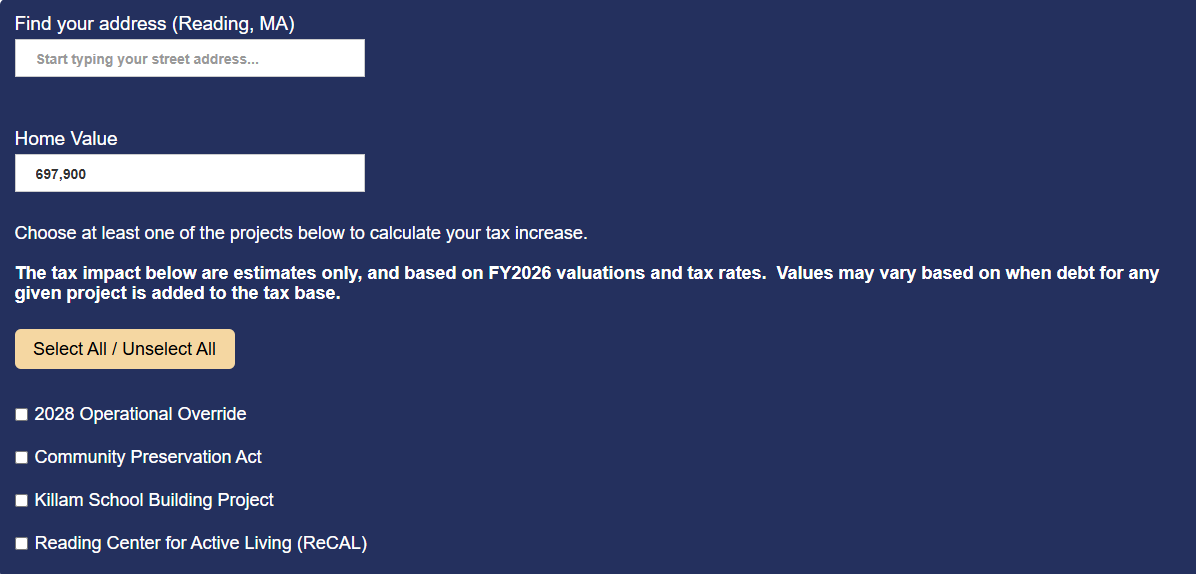
Screenshot of the Town of Reading property assessment database.
Step 2: Review your estimate
Once your property is entered, the calculator returns an estimated annual tax impact based on how the ballot questions are decided. The estimate also includes the Killam Elementary School and Reading Center for Active Living (ReCAL) projects, so residents can see the total impact on their household.
Examples of yearly tax impacts
These are based on current cost estimates for both the Killam and ReCAL projects, as well as the override and the Community Preservation Act (CPA).
Below-average Reading home: $697,900 → estimated impact override and CPA: $621.13; total impact with Killam and ReCAL: $1,390.77
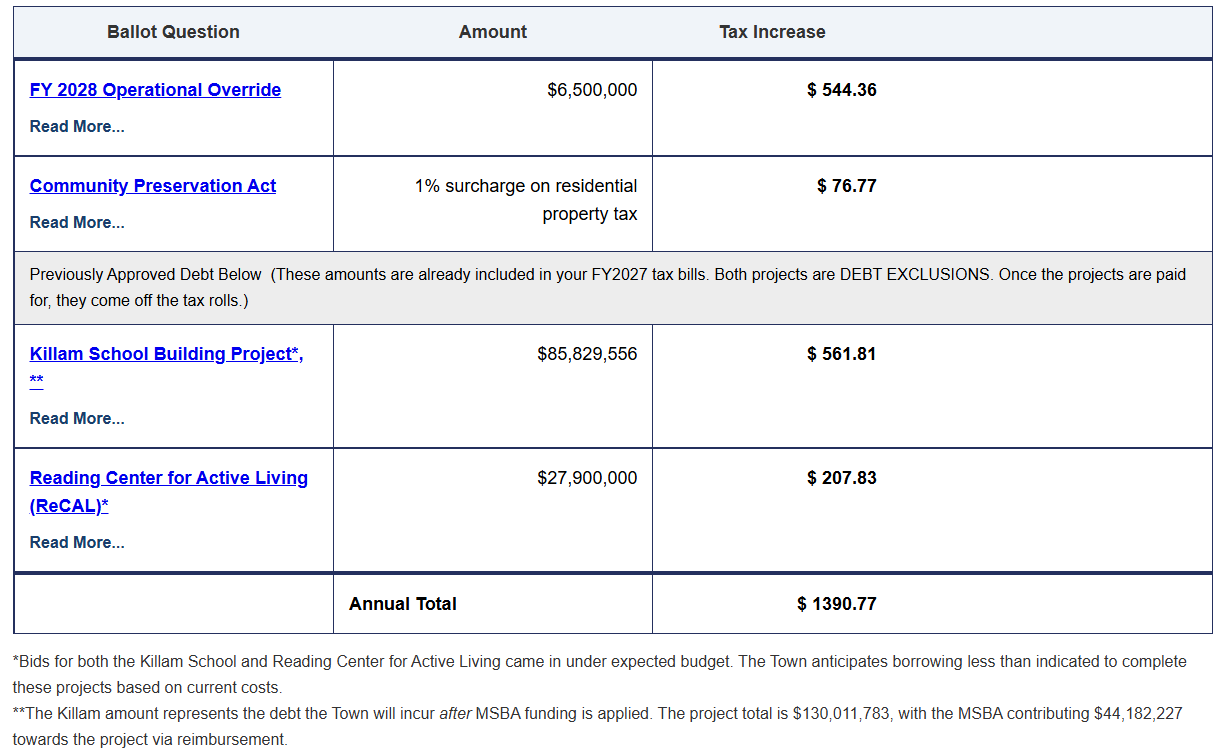
Tax impact on a home with a value of $697,200
Average Reading home: $944,200 → estimated impact override and CPA: $884.84; total impact with Killam and ReCAL: $1,981.24
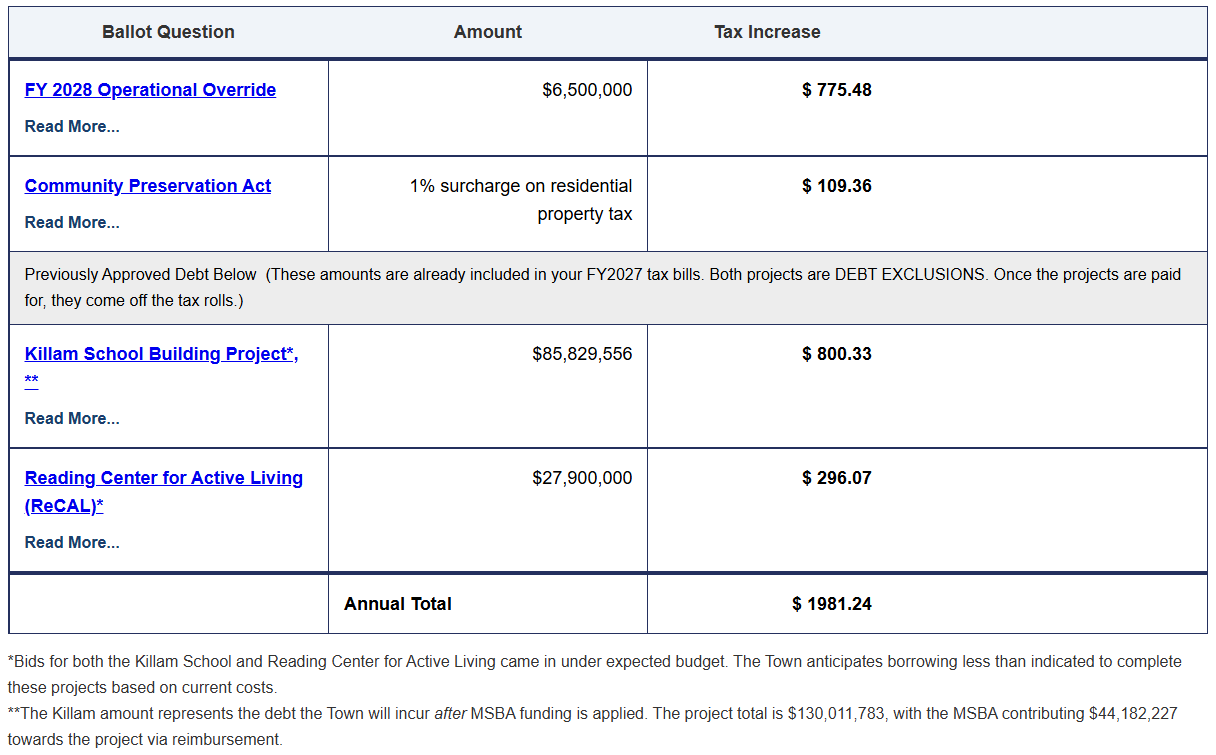
Tax impact on a home with a value of $944,200
Above-average Reading home: $1,190,500 → estimated impact override and CPA: $1,059.54; total impact with Killam and ReCAL: $2,372.42
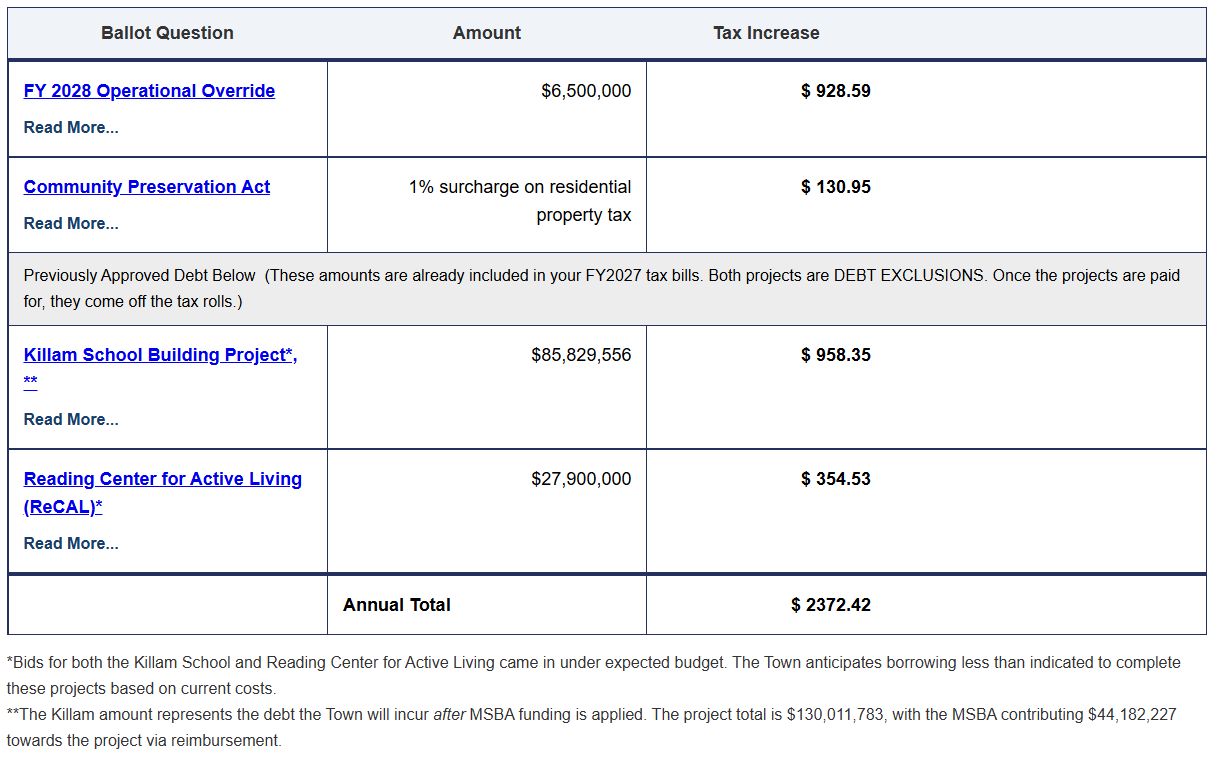
Tax impact on a home with a value of $1,190,500
The final number reflects the combined yearly tax impact for both projects, based on your home’s assessed value.
Killam and ReCAL are not new ballot questions
The Killam and ReCAL projects are included in the calculator to provide a full picture of a household’s costs, but they are not new questions on the November ballot and are separate from the proposed FY28 operational override. Bids for both projects came in below their expected budgets, and based on current costs, the town anticipates borrowing less than originally indicated to complete the work.
How the increases are phased
The tax impact from Killam and ReCAL does not arrive all at once. The first tranche of borrowing for the two projects appeared on residents’ July FY27 household bills and accounts for more than half of the projects’ costs ($50M for Killam and $20M for ReCAL). The second tranche will be considerably smaller, particularly because the bids came in under budget.
In practical terms, the remaining Killam and ReCAL increase is expected to be only about 35-40% of the first increase. For example, a household whose bills rose by about $600 for the two projects this year would see a remaining increase of roughly $225, rather than the $400 or more that earlier projections suggested.
Spread out, that leaves residents with three years of phased increases:
Killam and ReCAL, part one: this year (FY27)
Override and CPA: next year (FY28)
Killam and ReCAL, part two: the following year (FY29)
Learn more
More information is available on the town’s FY28 Override webpage. Residents can email questions to Override@ReadingMA.gov.
