RMLD’s 2025 Annual Report: reliable service, new rebates, and a new-carbon push
(4-5 minute read)
Reading Municipal Light Department has released its 2025 Annual Report, covering a year the utility describes as a “reinvestment in community connections” alongside continued focus on reliability, affordability, and the shift to non-carbon power. RMLD, established in 1894, is the largest of Massachusetts’ 40 municipal light departments by electricity load and serves more than 70,000 residents across Reading, North Reading, Wilmington, and Lynnfield Center. The full report is available on RMLD’s website. Here’s what stood out.
2025 by the Numbers
RMLD delivered 641,984,536 kWh of energy in 2025 across 1,274 miles of overhead and underground cable, supporting 32,159 meters. The utility recorded 99.99% network uptime, a 98% customer satisfaction rating, and a 98% utility trust rating in its spring 2025 customer survey. The system’s coincident peak, the single hour when regional demand is highest, hit 126 MW on June 24 between 6 and 7 pm. RMLD fielded 16,165 calls and 2,168 trouble calls over the year and added 195 new services.
New General Manager Jason Small, who stepped into the role after eight years on RMLD’s Citizens’ Advisory Board and 17 years as a residential customer, noted in his letter that the RMLD team is keeping reliability metrics ahead of local and national averages.
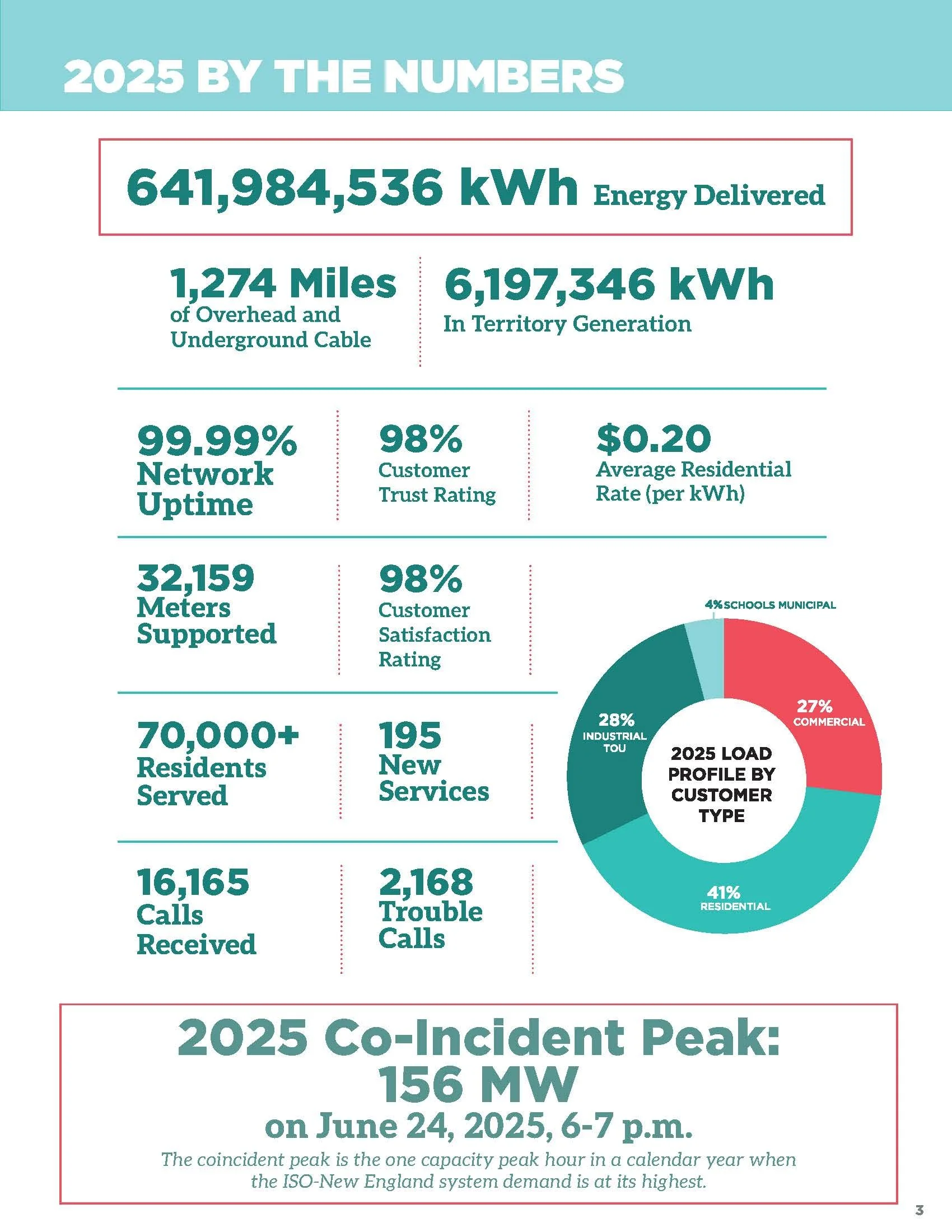
RMLD’s “2025 by the Numbers” infographic from the utility’s annual report.
Reliability held well above industry benchmarks
RMLD reported an average service disruption of about 20 minutes per customer in 2025, down from 23 minutes in 2024 and well below the regional average of 38 minutes and the national average of 54 minutes, according to APPA benchmarking data. The utility’s SAIFI (how often the average customer loses power) was 0.48 for the year, compared with a regional average of 0.8 and a national average of 0.94.
The leading causes of RMLD’s 2,168 trouble calls in 2025 were tree-related issues (47), equipment problems (35), wildlife (28), and weather (16); power supply issues caused zero outages. To stay ahead of problems, RMLD replaced 187 transformers, 193 poles, and 293 meters over the year and marked 4,708 underground locations for DigSafe calls. The utility noted that 28% of its transformers system-wide are now more than 25 years old, compared with an average lifespan of 30 years.
Rebates expanded, and bills stayed well below investor-owned utilities
RMLD says its typical residential customers paid about $161 a month in 2025, 50% to 60% less than comparable bills from investor-owned utilities like Eversource, National Grid, and Unitil, which the report puts at $262 to $355 in 2024.
The utility expanded its incentive programs significantly in 2025, headlined by a new heat pump rebate or 0% interest loan program launched in partnership with Reading Cooperative Bank, one of only six municipal heat pump loan programs in Massachusetts. Customers can choose a rebate of up to $2,000 per ton (max $8,000) or 0% financing up to $40,000 over seven years. RMLD also doubled its maximum commercial custom rebate to $100,000 and introduced new rebates for all-electric new construction. In total, RMLD issued 638 rebates worth $1.2M in 2025, led by 128 heat pump rebates ($554,690) and 22 solar rebates ($469,288).
RMLD’s demand-response programs, including the peak alert program (2,648 enrolled), Connected Homes (147 enrolled), Time-of-Use rates (996 enrolled), and Commercial Peak Demand Response, combined with reductions from RMLD’s own generation and storage assets, will save an estimated $2.2M in transmission and capacity costs in 2025.
Holding steady well ahead of the non-carbon mandate
RMLD’s share of retired non-carbon certificates climbed sharply over the past several years, from 20% of kilowatt-hour sales in 2020 to 55% in 2024, and held at that same 55% level in 2025. That keeps RMLD six years ahead of the state’s mandate of 50% non-carbon power by 2030 (the mandate rises to 100% by 2050). New solar and wind contracts began production in early 2025, totaling 28,000 MWh for the year. Certificate sales generated $4.8M in revenue, which RMLD says helps stabilize fuel charges for customers.
On May 13, RMLD commissioned its second battery storage facility, the 10MW River Park Energy Storage System at the Teradyne campus in North Reading, with a ribbon-cutting attended by local officials and industry partners.
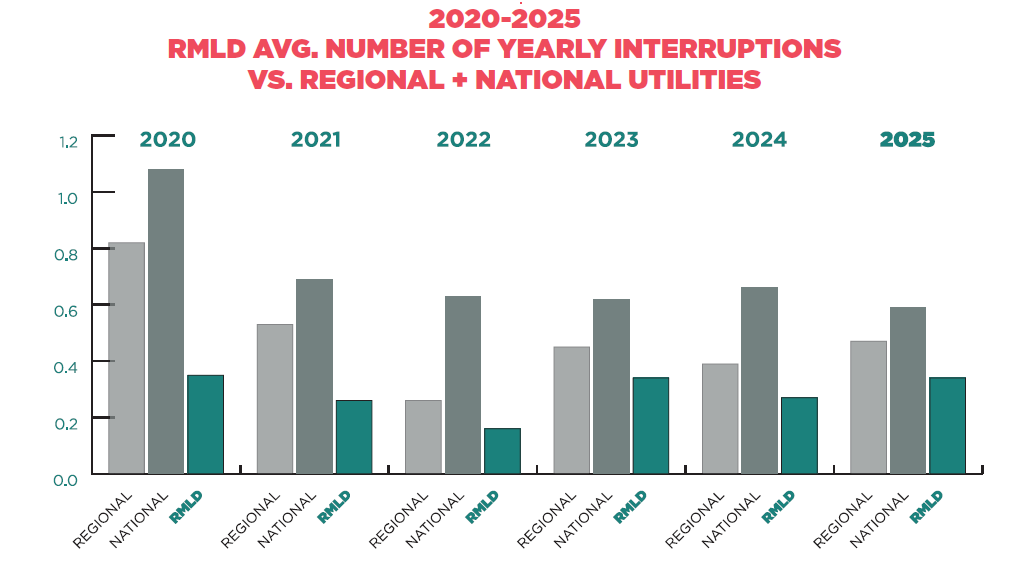
RMLD’s average yearly interruptions compared to regional and national utilities, 2020-2025.
Community engagement and recognition
RMLD leaned into community events and education in 2025, including its October 9 Public Power Week Open House (300+ attendees) and August 24 Electric Vehicle Show in Wilmington (200+ attendees). The utility also rolled out a refreshed brand and redesigned website, launched a new customer energy-tracking portal, hosted safety training for 39 Reading firefighters, and donated more than 170 bikes at its annual bike recycling event in partnership with Reading Cares and the Reading Climate Action Committee.
RMLD earned several industry honors in 2025, including a Diamond designation as an APPA Reliable Public Power Provider, the APPA Safety Award of Excellence (Diamond level), and the APPA Certificate of Excellence in Reliability.
Financial snapshot
RMLD’s audited financial statements show a total net position of $170.8M as of December 31, 2025, up from $159.6M in 2024. The utility reported operating revenues of $118.2M against operating expenses of roughly $103.4M (up 12.47% from 2024), with purchased power, RMLD’s largest expense, rising to $72.2M. Electric sales, net of discounts, were $119.5M, a 13.2% increase over 2024, even as kilowatt-hours sold remained essentially flat. The department ended the year with no outstanding bonded debt and continues construction on a new Wilmington substation through 2028. The audit, conducted by CBIZ CPAs P.C., was completed on May 12, 2026.
Looking ahead
RMLD’s five-member Board of Commissioners, Chair Pam Daskalakis, Vice Chair Bob Coulter, and Commissioners Ray Porter, Rich Swanson, and Dave Talbot, continue to oversee the utility, advised by a Citizens’ Advisory Board with representatives from all four communities RMLD serves. In his letter, General Manager Small said the utility’s “targeted infrastructure improvements kept reliability metrics consistently better than local and national averages” and pointed to continued investment in non-carbon energy, demand management, and customer programs as priorities heading into 2026.
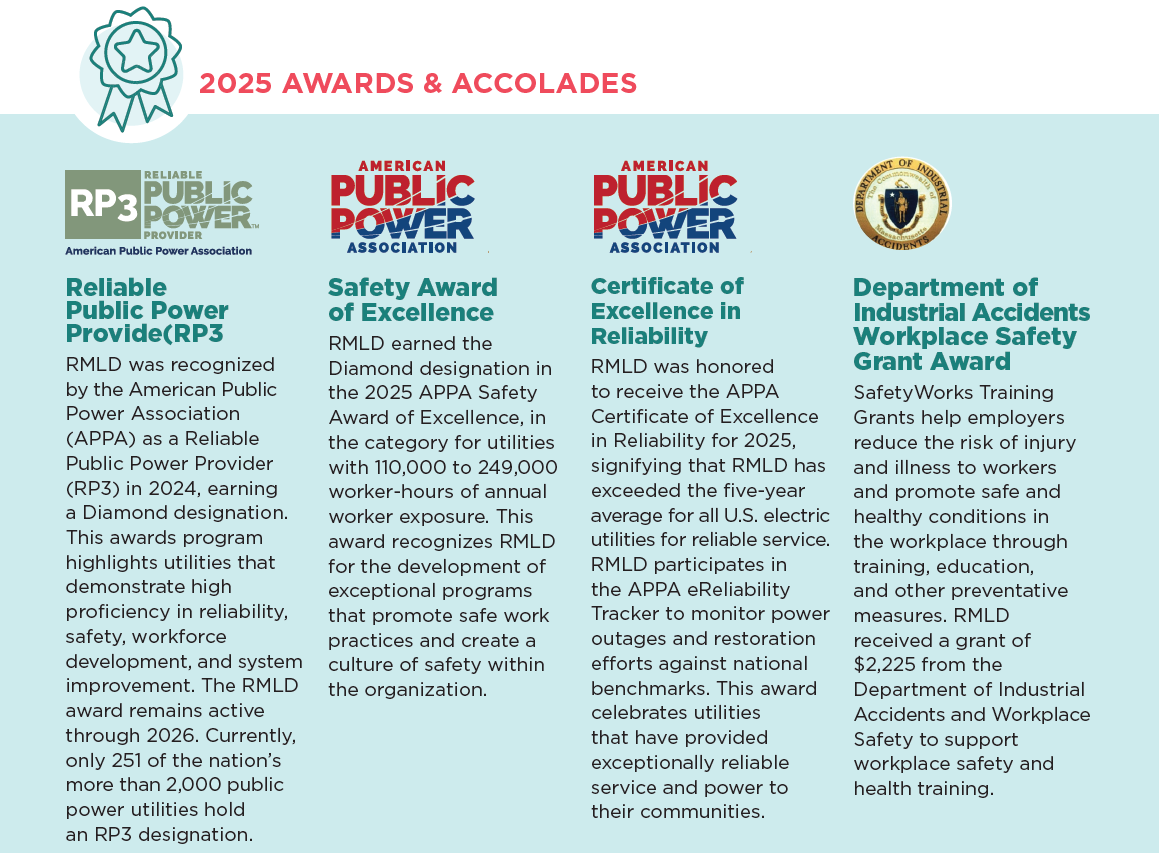
RMLD’s 2025 awards and accolades, as listed in the utility’s annual report.
