(4-5 minute read)
On December 2, 2025, Interim Massachusetts Department of Transportation (MassDOT) Secretary of Transportation and MBTA General Manager Phillip Eng issued a formal letter to local and state officials in Reading, announcing a significant shift in the long-discussed Reading Station Turnback Track project. The letter confirms that the MBTA has rescinded its Notice of Intent (NOI) for the proposed Vine Street site and will no longer pursue that location for turnback infrastructure.
The announcement comes after months of public concern, neighborhood opposition, and feedback from local elected leaders. Their decision marks a significant shift for the MBTA’s Regional Rail Modernization Program, which has been examining infrastructure upgrades aimed at enhancing commuter rail frequency and reliability across the network.
What the proposed Turnback Track would have done
In the letter, Secretary Eng outlines the original purpose of the turnback track project:
Increase weekday commuter rail service frequency between Reading and Boston, targeting trains approximately every 30 minutes from 5:30 am to 7:30 pm.
Allow trains arriving from Boston to turn off the main Haverhill Line, wait on a dedicated siding track, and then return southbound toward North Station.
Enable an inbound or outbound train to pause without blocking the mainline, giving Haverhill-bound trains priority while still improving service for Reading riders.
To achieve this, the MBTA had proposed installing 4,500 feet of new track on existing MBTA right-of-way near Vine Street. The plan was part of the agency’s broader modernization strategy, which includes increasing service frequency to match future electrification and clockface scheduling.
Why the Vine Street site was withdrawn
Secretary Eng acknowledges that the MBTA heard “valuable feedback from elected officials and residents” in Reading regarding the Vine Street plan. While the letter does not detail specific concerns, public comments over the past year have included:
Increased train noise in residential areas
Environmental and neighborhood impacts
Traffic and safety concerns near Vine Street
Questions about alternative locations closer to downtown or further north
After evaluating that feedback, the MBTA formally withdrew the NOI on November 12 and confirmed that the Vine Street area will no longer be considered as a site for the future turnback track.
What happens now? MBTA will continue exploring alternatives
Although the Vine Street proposal has been shelved, Secretary Eng makes clear that the MBTA is not abandoning the idea of building a turnback track altogether. Instead, the agency will:
Continue assessing other potential turnback locations along the Reading segment of the Haverhill Line
Maintain dialogue with Reading officials and residents
Keep the community informed as new options are developed
Importantly, Secretary Eng emphasizes that the MBTA aims to make decisions that “best support local needs while maintaining our focus on improving service along the corridor.” This indicates that any future proposal will likely involve more transparent community engagement from the outset.
What this means for the future of the project
The withdrawal of the Vine Street location represents both a pause and an opportunity for a reset.
The Turnback project is still alive - just relocated
The letter explicitly states that the MBTA continues to pursue improved service frequency and operational flexibility. The turnback track remains a key infrastructure tool for achieving that goal.
Community influence played a major role
Secretary Eng’s letter highlights the importance of public dialogue, signaling that resident and local official input can meaningfully shape major infrastructure decisions.
A new location will likely be proposed
While no alternative sites are named, several possibilities exist:
Closer to Reading Station, where some logistical advantages may exist
Further north, near areas with more commercial or industrial zoning
South of Reading, though this may present operational constraints
The MBTA will evaluate these options over the coming months.
Service improvements may be delayed
Without a confirmed location, the timeline for offering 30-minute all-day service between Reading and Boston becomes less certain. The project’s ultimate schedule will depend on environmental review, design work, community feedback, and funding.
A thank-you to Reading residents
Secretary Eng closes the letter with appreciation for the community’s engagement and a commitment to transparent communication moving forward. For many residents, this acknowledges both the importance of the project and the MBTA’s responsibility to balance system-wide benefits with local impacts.
Looking ahead
The MBTA’s decision marks a significant shift in the path toward modernizing commuter rail service for Reading and the surrounding communities. While the turnback track remains a strategic priority for improving reliability and frequency, its final location will depend on ongoing discussions, feasibility analysis, and collaborative planning.
For now, the withdrawal of the Vine Street proposal offers Reading residents a renewed opportunity to shape the future of rail service in town, while signaling that the Commonwealth remains committed to building a more robust, customer-focused transit network.
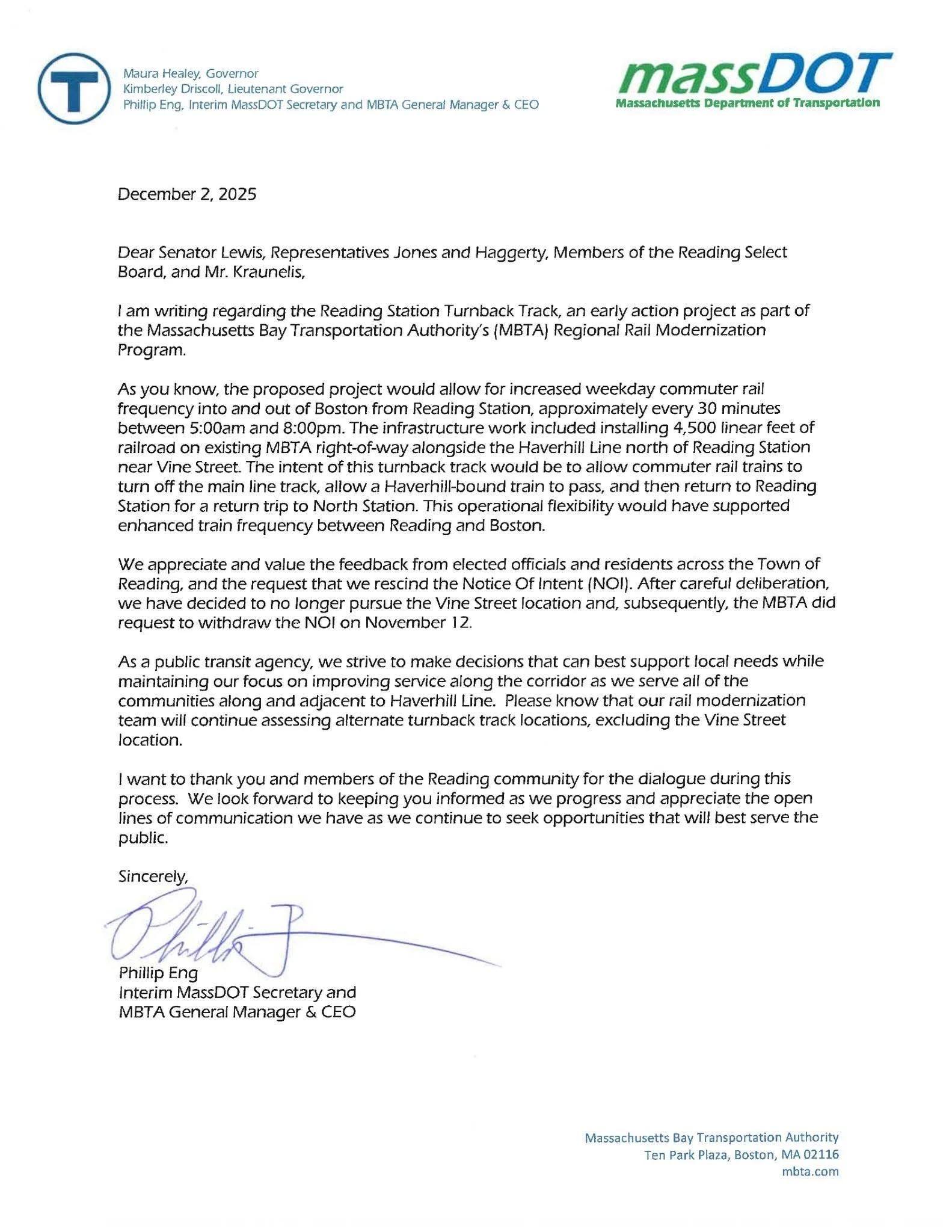
Letter from Interim MassDOT Secretary of Transportation and MBTA General Manager Phillip Eng.
