Council on Aging recap: January 21, 2026
(5-6 minute read)
For residents looking to stay up to date on key town matters, this recap highlights major takeaways from the Council on Aging (CoA) meeting held on Wednesday, January 21, 2026.
Watch the full meeting here on RCTV’s Youtube page.
Key takeaways
Focus remains on shaping ReCAL to meet senior needs.
Much of the meeting centered on feedback from the CoA Reading Center for Active Living (ReCAL) Working Group, emphasizing that the future facility must be designed, programmed, and operated in ways that genuinely serve Reading’s 60+ population.
Council members voiced the need for clarity before construction is complete.
Several members stressed the importance of addressing operational plans, programming expectations, and long-term costs now - well ahead of ReCAL’s anticipated opening in June 2027.
Upcoming at the Pleasant Street Center
The Council announced an upcoming informal conversation at the Pleasant Street Center to discuss the latest updates on ReCAL.
Thursday, January 29, 2026
2:00-2:30 pm
An open conversation with Reading’s Community Director Jenna Wood
Scheduled immediately following another PSC event to encourage participation from regular attendees.
Residents are encouraged to attend, ask questions, and share feedback.
Council on Aging ReCAL Working Group update & discussion
CoA member Nancy Ziemlak opened the discussion by acknowledging the extensive work completed by the ReCAL Working Group, noting it was driven by a strong sense of responsibility to Reading’s sizable 60+ population.
Ziemlak shared a document compiling CoA feedback from a joint meeting between the Recreation Committee and the Council on Aging held on December 15, 2025. The document paired presentation slides with CoA comments to clearly reflect concerns and suggestions. She emphasized that the final document was intended to gather feedback from the full Council before finalization.
Key themes in the ReCAL Working Group comments
Dedicated programming space: Additional designated space for 60+ programming is needed to allow for concurrent activities within the ReCAL facility.
Daily lunch options: Members requested consideration of potential lunch options, noting there are no nearby walking-distance food options at the planned site.
Recreation vs. senior center: Council members emphasized that senior activities should not be treated as revenue-generating ventures and asked for a clearer distinction between a “recreation center” and a “senior center.”
Operating hours and programming clarity: Members requested clearer definitions of “activities” versus “programs.”
Ongoing evaluation: The Council may consider independent audits multiple times per year to assess outreach, participation, programming success, and service delivery.
When questions arose about whether tone and content reflected the full Council, Ziemlak and several members confirmed that all CoA member comments were included. Member Marilyn Shapleigh reinforced that the Working Group invested significant time in the document and thanked the group for its efforts, noting the current phase is about broader Council feedback.
Operational planning and cost concerns
Discussion also focused on the need for an operational plan as ReCAL approaches its anticipated June 2027 opening.
Several members expressed concern that operational costs were not included in the debt-exclusion vote, raising questions about the combined financial impact of the ReCAL and Killam projects on resident tax bills in FY27.
Jenna Wood explained that the Town hired an operational budget consultant to develop a base plan, which the Operational Working Group is now using. She noted that an operational plan was not initially developed because determining whether the project would move forward was the first major hurdle.
Assistant Town Manager Jayne Wellman added that the Town is thinking about FY27 and FY28 concurrently, as ReCAL’s operational costs are expected to appear in FY28.
Additional questions and requests for collaboration
CoA member Ron Powell shared a separate document outlining areas needing further clarity and collaboration between the CoA Working Group and Town Staff to support long-term financial sustainability:
Operating budget alignment: Ensuring programming expectations and staffing needs are clear now to avoid costly adjustments after the facility opens.
Resident needs and long-term vision: Members requested a five-year master plan outlining how current and future senior needs will shape design, programming, and services.
Uniqueness of senior center space: Council members asked for a mock month-long programming schedule to confirm the facility can support both structured and unstructured activities without conflicts.
Collaboration: Opportunities remain to strengthen early collaboration between Town staff and CoA members to better inform design and operational decisions.
As discussions continue, Council members emphasize the importance of transparency, shared planning, and early problem-solving to ensure ReCAL opens as a welcoming, functional, and sustainable resource for Reading’s older adults.
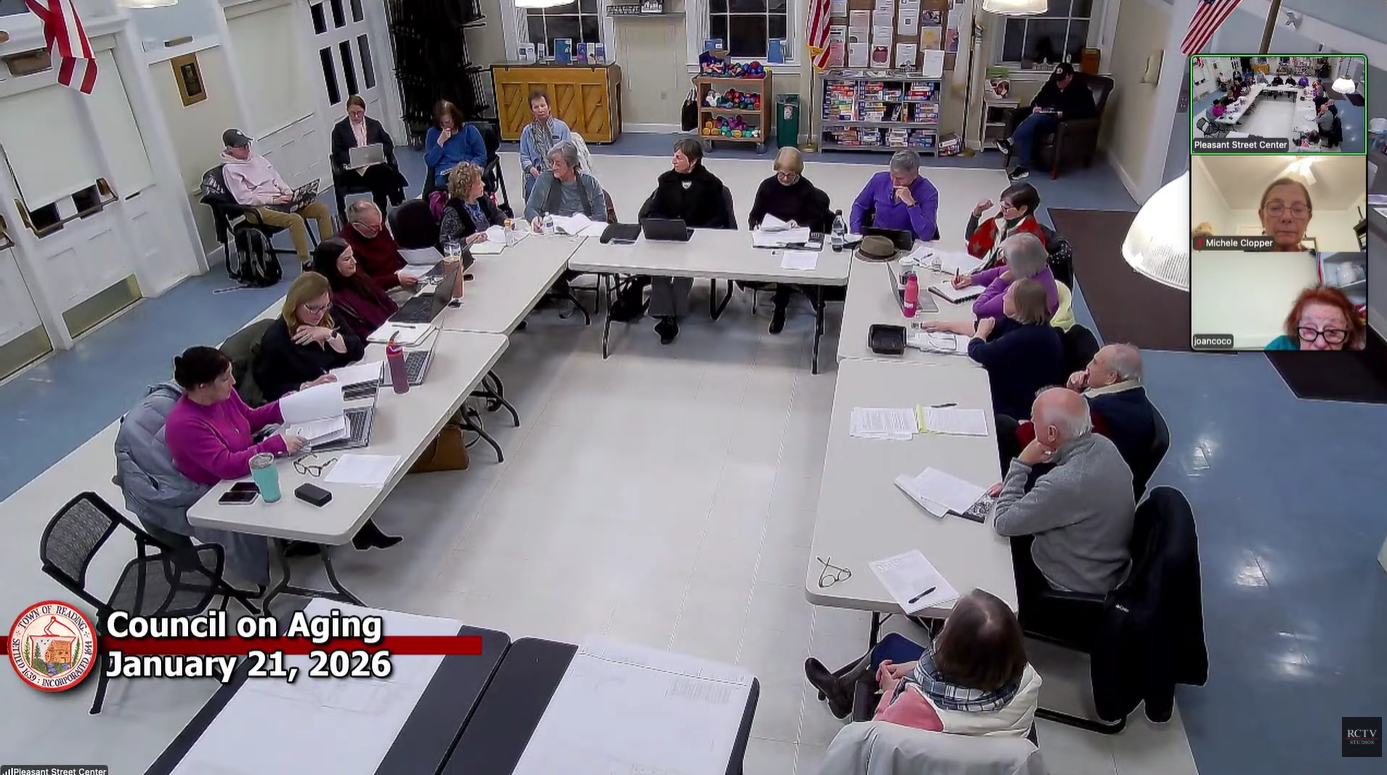
Image of the January 21, 2026, Council on Aging meeting from the RCTV Youtube page.
