MA-5 State Senator candidate forum: August 8, 2026
(9-minute read)
For residents looking to stay up to date on key town matters, this recap highlights the major takeaways from the Massachusetts Fifth Middlesex State Senator candidate forum held on Saturday, August 8, 2026.
Watch the full meeting here on Stoneham TV’s website.
Key takeaways
The forum was for the open Fifth Middlesex Senate seat being vacated by Senator Jason Lewis, with three democrats competing ahead of the September 1 primary.
Affordability was the dominant theme, and all three candidates stressed housing, childcare, and cost of living, though they differed in emphasis and approach.
The candidates aligned on several questions, including opposing the Question 5 revenue cap, supporting Question 1 public records expansion, and implementing the vote-approved legislative audit, while splitting on others such as congestion pricing.
Introduction
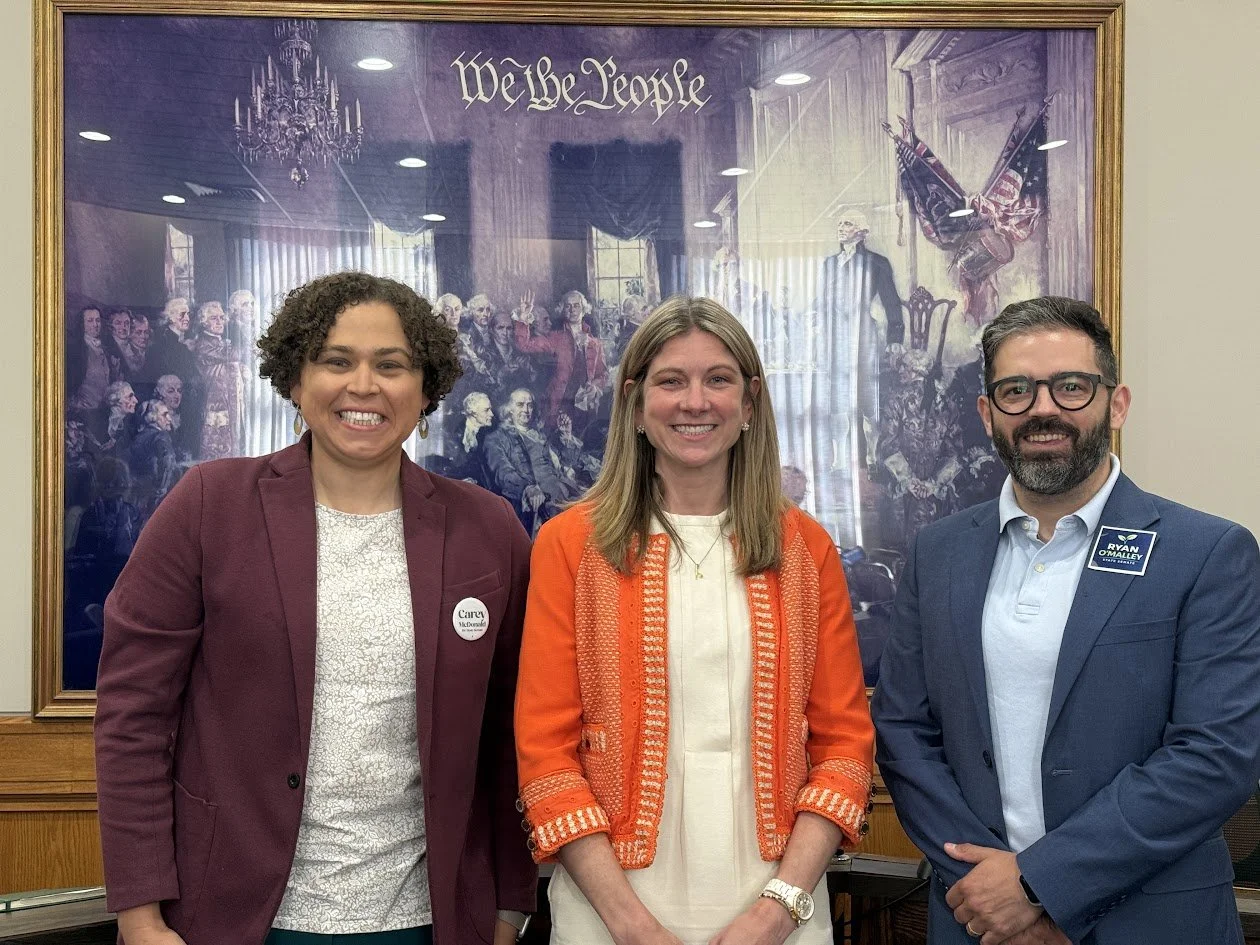
Fifth Middlesex State Senate candidates, from left, Carey McDonald, Kate Lipper-Garabedian, and Ryan O’Malley at the League of Women Voters forum. Photo by Taylor Gregory.
The forum was hosted by the Winchester & Melrose League of Women Voters, which Lynn Brodky described as a nonpartisan group that works to inform voters and advocate for ballot and policy measures without taking positions on candidates. The seat carries a two-year term. The Fifth Middlesex district covers Malden, Melrose, Reading, Stoneham, Wakefield, and part of Winchester, and the seat is open because Senator Jason Lewis is not seeking reelection. Margaret Coppe moderated, and the format gave each candidate two minutes for opening and closing statements, with short-form questions and longer follow-ups in between.
The three candidates, presented here in the order they appear throughout this recap, were Carey McDonald (they/them), Ryan O’Malley (he/him), and Kate Lipper-Garabedian (she/her).
Opening statements
McDonald introduced themselves as a three-term Malden City Councilor At-Large, a working parent, and a former chair of Malden’s Finance Committee. They cast themselves as a fresh voice ready to fight for the district’s communities, claimed to be the only candidate to have sued the Trump administration, and pointed to affordability, transparency, and democracy as priorities.
O’Malley described himself as a product of Malden public schools and works as an attorney, and said that reforming how the state funds education is central to his campaign, drawing on his experience with local overrides. He credited early intervention services with helping him get on track to attend Holy Cross, and touted an endorsement from the Massachusetts Teachers Association and his support for government accountability and the legislative audit.
Lipper-Garabedian presented herself as a candidate with the values and Beacon Hill track record to deliver for the district. A former public school teacher and education attorney in her sixth year as a state representative, she cited her work on public education and housing bills, $5.3M she said she brought back to the district she serves, and endorsements, including one from Jason Lewis.
The forum
Ballot Question 7, on single-family home zoning (yes or no)
McDonald and O’Malley both said yes; Lipper-Garabedian said she was leaning yes.
What they would do to reduce the burden of rising costs while balancing community input
McDonald called housing a cornerstone of life, pointing to two-and three-family homes, accessory dwelling units, and removing restrictions to allow for greater housing production, along with income-based affordable housing and dedicated funding sources.
O’Malley said many neighborhoods are nonconforming and argued the state should build near transit to make communities more livable and less car-dependent, and he warned that doing away with Proposition 2 ½ would only push problems further down the road.
Lipper-Garabedian said the state has underinvested in housing for decades, expressed support for accessory dwelling units by right, and pointed to legislation enabling smaller senior housing options while calling for more input from municipalities.
What legislative reforms they would pursue to address high costs
McDonald focused on childcare, noting Massachusetts is among the most expensive states, and proposed treating childcare as tax-exempt use and expanding vouchers while supporting the providers, often immigrant women, who do the work.
O’Malley called for universal pre-kindergarten and for using regulatory levers to bring down utility costs for ratepayers.
Lipper-Garabedian agreed childcare is a major burden, citing efforts to find state funds to offset lost federal funding, argued that transit investment drives down costs, and mentioned a bill to eliminate copays for certain drugs.
Their view of the formula for local aid, and what they would change
McDonald called the current approach an example of Beacon Hill missing urgency, noted that Reading, like many communities, just placed an override on the fall ballot, and said aid should be equitable, account for communities with smaller commercial bases, and incentivize housing.
O’Malley said there is no real formula and that aid is distributed based on favors to leadership rather than need, and he called for revamping the Chapter 70 education formula to reflect a district’s ability to pay.
Lipper-Garabedian cited six years of advocating to return money to towns, a 50% increase in Chapter 90 funding since she took office, and said unrestricted local aid tends to build on the prior year’s amount rather than follow an intentional formula.
Ballot Question 5, on capping state tax revenue (yes or no)
McDonald, O’Malley, and Lipper-Garabedian all said no.
How the legislature should respond if Question 5 passes
McDonald said it would force cuts to schools, higher education, and healthcare, and said they favor the Millionaire’s Tax (Fair Share Amendment) and broader reform, drawing on Malden’s experience after a recent failed override.
O’Malley said Massachusetts relies too heavily on property taxes and should consider progressive taxation based on ability to pay, and he criticized governing by ballot questions.
Lipper-Garabedian noted the Legislature has passed tax relief for working families, seniors, and renters, and warned that passage would be especially damaging as federal funding is being pulled, since the state cannot run a deficit the way the federal government can.
Whether the legislature should follow through on the 2024 voter-approved audit of the Legislature (yes or no)
McDonald and O’Malley both said yes; Lipper-Garabedian said yes, within the limits of the constitution.
Ballot Question 1, on expanding the public records law to cover the legislature and governor’s office (yes or no)
McDonald, O’Malley, and Lipper-Garabedian all said yes.
Specific changes they would make to increase transparency
McDonald said Massachusetts is the only state whose government exempts itself from rules other officials follow, with votes that go unrecorded, and called for recorded votes and moving forward with the audit.
O’Malley pointed to leadership’s use of stipends and committee assignments to reward or punish members, called for changes to state ethics laws, and said legislators should follow the same open-meeting and public records rules as every city and town.
Lipper-Garabedian cited her own practices, including monthly office hours, newsletters explaining her votes, and answering constituent emails personally, and voiced her support for expanding the audit.
Whether they support the use of surveillance (yes or no)
McDonald, O’Malley, and Lipper-Garabedian all said no.
Whether they support the comprehensive data bill barring companies from selling personal data and allowing individuals, not just the government, to sue
McDonald raised concerns about Flock camera surveillance, called for statewide standards and limits, and supported letting individuals sue companies over their data.
O’Malley said a functioning legislature would already have such protections in place, argued that residents should own their data, and said people should have to opt in to artificial intelligence rather than opt out, with a private right to action.
Lipper-Garabedian cited data-privacy legislation that advanced with a private right of action, along with related work such as the Shield Act and efforts addressing phones and social media use in schools.
What action they would take to handle service disruptions from lost federal funding
McDonald said the Trump administration is endangering residents and backed going to court, drawing on reserves, and buffering losses for people who have lost jobs and coverage, and they voiced support for a single-payer approach.
O’Malley pointed to a housing justice clinic and social safety nets to keep people housed and fed, and called for a public option in healthcare.
Lipper-Garabedian said she hosted a community conversation on federal budget law, described this as a stormy day for tapping reserves, defended universal school meals, and cited seeking flexibility in MassHealth coverage.
What state measures could help with national and international pressures on Massachusetts
McDonald called for canceling contracts with ICE, ensuring no state money supports federal immigration enforcement, and instead supporting immigrant networks.
O’Malley emphasized growing the local economy through education, startups, and business creation to weather national economic storms.
Lipper-Garabedian focused on instability around immigration, cited the Protection Act barring the use of state funds to assist federal immigration enforcement, and stressed letting people attend court and appointments without fear.
Congestion pricing (yes or no)
McDonald said they are open to it, O’Malley is opposed, and Lipper-Garabedian said tentatively, yes.
Next steps to improve public transit service and accessibility, and how to pay for it
McDonald credited the Fair Share Amendment for transit capital, called for more buses, later hours, and expanded fare-free service, and described congestion pricing as one possible piece.
O’Malley, a daily transit and multimodal rider, said the state should improve service to give people alternatives to driving rather than turn to congestion pricing, and called for better bus routes and for double-tracking and electrifying the commuter rail in the district.
Lipper-Garabedian called the district a transit hub, cited pushing back on pandemic-era service cuts, improving station accessibility, and the low-income fare program, and voiced support for regional connectivity and microtransit grants.
What they would do to invest in education, technology, and bioresearch
McDonald pointed to backfilling federal research funding, supporting small businesses and incubators, and noted that housing and healthcare costs make it harder to innovate.
O’Malley called for more funding through progressive taxation and emphasized vocational schools, manufacturing, robotics, and job training.
Lipper-Garabedian cited a College in High School bill, her role as House chair of the Emerging Technology Committee, and her efforts to encourage innovation across all sectors.
Closing statements
McDonald returned to school funding as the most important issue for the district, citing their work to change the Chapter 70 formula, and reaffirmed his commitment to LGBTQ+ and immigrant rights and to affordability, noting endorsements from unions and the mayor of Malden.
O’Malley cast himself as a fierce defender of the immigrant community, citing his Irish and Italian heritage, and pledged to bring common sense and accountability to Beacon Hill, arguing that a child’s zip code should not determine where they end up.
Lipper-Garabedian thanked the participants and praised the positive tone of the campaigns, and she said she has the values and the track record of success to deliver results on affordability for the district’s families.
