(10-minute read)
For residents looking to stay up to date on key town matters, this recap highlights the major takeaways from the Override session held Wednesday, October 21, 2026, at Joshua Eaton Elementary School.
Key takeaways
No silver bullet. Superintendent Dr. Henry Turner reiterated that the district faces a $3M to $4M cut without an override, and that no single scenario avoids hitting classrooms, since 81% of the budget is staff.
Programs built over a decade are at risk. Panelists described arts, athletics, school adjustment counselors, team chairs, and the middle school team model as the positions and programs most exposed to cuts, warning that rebuilding them after they're lost could be difficult.
Joshua Eaton as a turnaround story. Principal Caitlin Shelburne presented data showing the school moved from the bottom 20% of Massachusetts elementary schools in 2015 to the top 15% today, crediting the staffing and programs now on the chopping block.
Turner on how schools have changed

Hand-painted murals and floor decals brighten a hallway at Joshua Eaton. Photo by Taylor Gregory.
Superintendent Dr. Henry Turner opened the session by framing Joshua Eaton as representative of the district’s broader progress, noting the school has gone from one of Reading’s lowest-performing schools to one of its highest over the past decade. During the tour that followed, he encouraged attendees to notice who was doing the talking: the kids or the adults.
Turner said the budget scenarios discussed at the October 15 School Committee meeting show no single cut solves the $3M to $4M gap without an override. He pointed to absenteeism as one sign of shifting needs: roughly 10% of students missed 18 or more days of school before the pandemic, now down to about 4%, compared with 17% in a district he previously worked in, where even a one-point improvement would be significant.
Turner said many of the district’s newer-sounding positions, such as school adjustment counselors, team chairs, and assistant principals, came from restructuring existing roles rather than new spending, and that the district remains lean even as it has added literacy and math curricula and social-emotional learning support. He also cited the district’s work keeping students with significant needs in-district rather than in out-of-district placements, which state law requires the district to fund if it cannot meet a student’s needs internally. That work has saved the town an estimated $12.85M and generated $285,000 in revenue from other districts, he said.
Panelists on what an override failure would mean
Reading Business Administrator Josh Delaune moderated a panel discussion with Assistant Principal Jessica Swidell of Joshua Eaton Elementary, Principal Alissa Gallegos of Barrows Elementary, history teacher and Reading Teachers Association President Jessica Bailey, Principal Jessica Callanan of Reading Memorial High School, and Principal Sarah Marchant of Coolidge Middle School.
Classrooms and staffing
Asked what would happen in classrooms if the override fails, Gallegos said she has seen firsthand, as both a principal and a parent, the benefit of the district’s current supports, and that cuts would make it harder to build schedules that target instruction to individual students. She said Barrows had kindergartners crying in each of the first four weeks of school this year, requiring her assistant principal’s help to keep classrooms running, and that tier 2 interventions, like tutors and adjustment counselors, would be among the first affected.
Swindell agreed, adding that staff constantly respond to student needs in the moment, with no built-in time to help students catch up or get additional support if positions are cut.
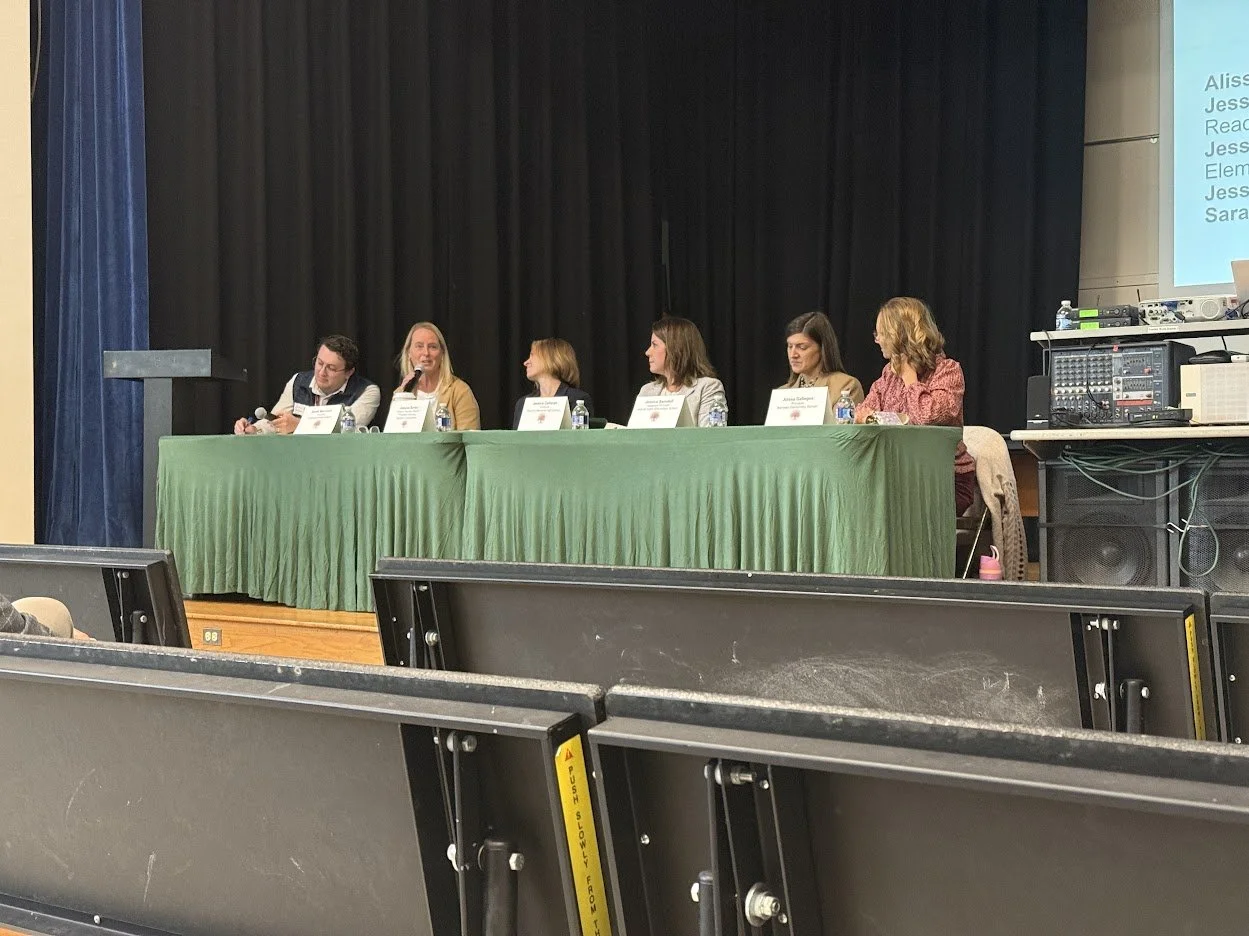
School and district leaders field questions during the override session’s panel discussion at Joshua Eaton. Pictured (left to right): Josh Delaune, Sarah Marchant, Jessica Bailey, Jessica Callanan, Jessica Swindell, and Alissa Gallegos. Photo by Taylor Gregory.
Callanan broke down the district’s spending by level of schooling, roughly $1M in cuts at each level, saying there is no way to cut without affecting staff. She credited strategic planning for the district’s growth and said out-of-district savings depend on staff who can support those students. She noted that RMHS runs with three assistant principals and an athletic director rather than the five some comparable schools have, letting her focus on instructional leadership while the assistant principals manage daily needs.
Bailey said there is no way to fully minimize the impact on students and staff, since the most recently hired, and often youngest, staff are typically let go first, despite often being best able to relate to younger students. She said the loss would also hurt morale and increase class sizes, with less funding for trips, clubs, and other extras.
Marchant said several of the same themes apply at the middle school level, where the team model supports the whole child during a developmentally challenging age. She said the model’s schedule and structure are deeply intertwined, and that Coolidge currently has two school adjustment counselors, one METCO-specific, ensuring students get social-emotional support before problems escalate rather than only once more serious intervention is needed.
Programs built over time
Callanan, who started as an assistant principal five years ago, highlighted the district’s Innovation Career Pathways program, which she helped build with more than $1M in grant funding. The program now includes six pathways and more than 300 students, teaching skills like resume-building alongside 10 dual-enrollment credits and 30 AP courses, with more than 600 tests taken district-wide and an 83% passing rate among students earning college credit. She said RMHS has two adjustment counselors and two team chairs, who work nonstop throughout the day and are essential because about a quarter of students have IEPs.
Swidell described her role as supporting the principal as needed, including managing roughly 55 students’ 504 plans and out-of-district placements, evaluating 32 teachers, and serving as a first line of support for students’ social and emotional needs. In her first year as principal, Gallegos said she advocated for more administrative coverage at Barrows before the position existed under former Superintendent Dr. Thomas Milaschewski.
Decisions and definitions

A bulletin board at Joshua Eaton collects students’ answers to why they love art. Photo by Taylor Gregory.
Asked to explain a 504 plan, Swindell said it differs from an IEP because a 504 is a civil rights plan for students who need accommodations but don’t qualify for an IEP under special education law.
Asked how program priorities are decided, Callanan said it is a collaborative process ultimately left to the superintendent and School Committee, with principals offering recommendations, adding that she has lost sleep over ongoing conversations about what cuts might look like.
Schools since the pandemic
Asked how much schools have changed since the pandemic, Bailey said she wasn't sure how much to attribute to COVID-19 versus the broader rise in technology use, and that literacy needs have shifted, requiring teachers at every level to also serve as literacy instructors. She said students now carry stress home in new ways and face more behavioral challenges than before, driving the need for more staff even as expectations for college and career readiness have risen. Gallegos said the same dynamic shows up at the elementary level, where shrinking attention spans mean teachers must actively build students’ stamina to sit still and work through difficult tasks.
Community questions and concerns
Investing now versus paying later
Several residents spoke during the session's Q&A. One mother said she hoped the session had been recorded so she could share it with other parents, arguing that investing now would be cheaper than paying for out-of-district placements later if the override fails.
Turner agreed, noting that families sometimes choose private school for programs Reading can no longer offer, pointing to arts programs as currently the most vulnerable and noting a parent at last week’s School Committee meeting who considered private school for the arts before staying in Reading. He said athletics face similar risk, and that the district has kept hockey players in Reading who might otherwise have left for private schools. Gallegos added that athletics helps students connect with peers and the community and stay accountable for attending school.

Student-made “Multiple Monsters” line a hallway, part of a math lesson on skip counting. Photo by Taylor Gregory.
Class size and classroom support
Another parent praised the Innovation Career Pathways program and asked about class size. Bailey said reasonable class sizes are essential to giving every student individualized attention, noting her public speaking classes benefit from a roughly 15-student ratio that allows students to give and receive meaningful feedback, something far harder to replicate in a larger class. Swindell said elementary schools already rely on small-group instruction to meet students where they are. Gallegos added that teachers need time to plan around students with IEPs and 504 plans, and that the district tries to cap those students at five per classroom to protect instruction for everyone.
Redistricting and the long view
Another resident asked about repeating the session and rumors of redistricting. Turner said redistricting is a possibility but not confirmed, and that raising elementary class sizes to 28 alongside redistricting could reduce staffing by about 10 positions. He said the district has also looked at rebalancing Parker and Coolidge, though Coolidge may lack the capacity, and at creating grade 5/6 and 7/8 school configurations, which would require a space study and affect all students. He noted this information was shared at the October 15 School Committee meeting.
Asked how seriously the district weighs state rankings, and whether sending more students out-of-district could affect them long-term and the town’s appeal to families, Turner said the district would continue showing up for students regardless, but acknowledged a decade of repeated cuts takes a toll on morale even if effects aren’t immediately visible. He said Reading competes with private schools and benefits from School Choice enrollment, and that decisions about where to invest are ultimately values-driven.
A closer look at Joshua Eaton with Principal Caitlin Shelburne
Joshua Eaton Principal Caitlin Shelburne closed the formal portion of the evening with what she called a case study of the work happening across all the district’s elementary schools. She asked attendees to reflect on their own school experiences, what mattered most to them, and how they wanted to feel.
What families want for their kids
Residents who responded said they wanted children to feel included and accepted, safe and loved, and well prepared for life. One resident, who identified herself as Jewish, raised concerns about safety given recent events and said she wanted all children, including those facing anti-semitism, to feel protected.

A mural and sign welcome visitors to Joshua Eaton, “Home of the Jaguars.” Photo by Taylor Gregory.
How student needs have evolved
Shelburne said Joshua Eaton, known as the Jaguars, aims to create that sense of belonging through a combination of staff, programming, and services. She walked through how students’ needs have evolved: a more phone-based childhood, shrinking attention spans, rising stress and anxiety, and a cultural shift toward heightened caution sometimes described as “safety-ism.” She cited research showing the average attention span for a school-age child was about 2.5 minutes in 2005 and has fallen to 4-8 seconds today, requiring teachers to constantly adapt to keep students engaged. Shelburne said that where a student once had a teacher, a parent, and perhaps a counselor paying attention to their development, there are now often 10 or more adults involved, a shift that applies to all students, not only those with IEPs or 504 plans.
From Level 3 to top performer
Shelburne credited that expanded support system with the school’s turnaround: designated a Level 3 school requiring state intervention in 2015 as one of the bottom 20% of Massachusetts elementary schools, Joshua Eaton is not in the top 15% of elementary schools statewide and the top 5% for students with IEPs. She attributed the change to new curricula, professional development, assistant principals, a literacy specialist and tutoring team, social-emotional learning time, adjustment counselors, and added enrichment opportunities.
Touring Joshua Eaton

A “Push-up Wall” gives Joshua Eaton students a spot to get their energy out between classes, next to student desert paintings. Photo by Taylor Gregory.
Following the presentations, attendees toured the building and various classrooms to see how instruction has changed. Throughout the hallways, students have spots to release physical energy between classes, such as push-ups, crawling, and hopping stations. Joshua Eaton is one of the district’s schools with lockers, which students said gives them a sense of independence, and its halls are lined with hand-painted murals and student artwork; each classroom has its own animal mascot to build camaraderie.
The first-grade classroom visited was actually three connected rooms, each working on a different skill with its own educator, with some staff by both a lead teacher and a support educator. Students rotated between small groups tracked on a smart board timer: some read on tablets, others used physical books, and others sounded out words with a teacher. Shelburne noted the school’s strong sense of pride, which occasionally includes outdoor dance parties to start the day.
