Select Board Forum recap: March 18, 2026
(8-9 minute read)
For residents looking to stay informed ahead of the upcoming election, a Select Board candidates forum brought together the four candidates to discuss key issues facing the Town of Reading.
The forum was held at the Pleasant Street Center on Wednesday, March 18, 2026, and hosted by the Reading Democratic Town Committee, with candidates Carlo Bacci (incumbent), Karen Herrick (incumbent), Sal Bramante, and Tony D’Arezzo participating.
The event was moderated by Jennifer Hillery, and questions were asked by Tom Grant and Megan Filder-Carey.
Watch the full forum below on the RCTV Youtube page.
Key takeaways
Candidates diverged on affordability and tax strategy
While all acknowledged financial pressure, their approaches range from minimizing tax increases to leveraging new funding tools and structural changes.
Governance style and board conduct emerged as a major dividing line
Candidates differ sharply in how they characterized recent board dynamics and how they would lead moving forward.
Clear contrasts on timing and strategy for major policy decisions
On issues like CPA and adaptive sports funding, candidates agreed on goals but differed on timing, structure, and execution.
Opening statements [8:38]
Candidates used their opening remarks to frame their priorities and experience:
Carlo Bacci emphasized continuity and results, noting his goal of keeping Reading “moving in the right direction.” He highlighted his background as a small business owner and focused on completing major projects already underway, minimizing new taxes, and supporting seniors, veterans, and local businesses.
Karen Herrick highlighted her long history of public service, including decades as a Town Meeting Member and her time on the Select Board. She emphasized affordability, environmental stewardship, and inclusive governance, framing her work as rooted in collaboration with residents and town staff.
Sal Bramante focused on his deep ties to the community as a longtime resident and Board of Health member. He emphasized a multigenerational perspective and positioned himself as someone who understands families' needs at different life stages.
Tony D’Arezzo framed the role of Select Board members as one of responsibility rather than power, emphasizing accountability, humility, and the importance of working collaboratively to find solutions that benefit the entire community.
Budget challenges and the likelihood of an override [20:19]
Candidates were asked how they would address a projected budget shortfall, including whether to support an override, reduce spending, or pursue alternative strategies.
Bacci emphasized cost control and economic growth, stating he would avoid staff cuts if possible and look to expand the tax base through projects like the Eastern Gateway. He acknowledged an override is likely but focused on minimizing its impact through grants and disciplined spending.
Herrick focused directly on financial strategy, including smart borrowing, pursuing grants, and long-term planning. She emphasized maintaining services while recognizing limits on state aid, framing the issue as one of stewardship rather than cuts.
Bramante stated directly that an override was “inevitable,” but stressed approving the lowest possible amount and carefully evaluating spending, reflecting a business-oriented approach.
D’Arezzo argued the budget has already been reduced significantly and that further cuts would affect core services. He supported an override and emphasized the need to expand the tax base.
Key difference: Bacci and D’Arezzo emphasized growth and efficiency, Herrick focused on financial tools and planning, while Bramante centered on minimizing the override.
Community Preservation Act (CPA) [26:04]
Candidates were asked whether Reading should adopt CPA, which adds a surcharge to resident tax bills but unlocks matching state funds for projects relating to open space, recreation, historic preservation, and affordable housing.
Bacci opposed CPA at this time, citing concerns about an additional tax burden, particularly on seniors and vulnerable residents.
Herrick supported CPA, describing it as a way to maximize local spending power and fund projects the town is already undertaking.
Bramante supported CPA in concept but said the timing is not right, citing existing financial commitments.
D’Arezzo strongly supported CPA, framing it as a practical way to bring additional funding into the community.
Kay difference: Herrick and D’Arezzo supported CPA now, Bramante supported it later, and Bacci opposed it due to tax concerns.
Burbank funding and Article 14 [31:41]
Candidates were asked about directing Burbank Ice Arena rent into stabilization funds for adaptive sports and recreation.
Bacci supported the proposal, describing it as one tool among many and noting it emerged through negotiations.
Herrick raised concerns about process and reliability, noting that rent is not a consistent funding source and emphasizing the need for deliberate planning.
Bramante supported the programs but said funding should come from a stable line item, not tied to fluctuating revenue.
D’Arezzo agreed, arguing programs should not depend on Burbank's performance and should be funded directly.
Key difference: Bacci supported the funding mechanism, while the other three questioned tying programs to inconsistent payments.
Governance, tone, and Select Board dynamics [37:12]
Candidates were asked how they would address recent tensions on the Select Board.
Bacci acknowledged past tensions and emphasized teamwork, while also criticizing participation levels and pointing to completed work.
Herrick expressed concern about a decline in civility, emphasizing preparation, professionalism, and respect.
Bramante emphasized a calm, steady approach, focusing on respectful dialogue and thoughtful decision-making.
D’Arezzo emphasized collaboration and accountability, encouraging open discussion and solution-focused engagement.
Key difference: Bacci defended current dynamics, Herrick criticized them, while Bramante and D’Arezzo positioned themselves as stabilizing influences.
Role of local government in national issues [44:36]
Candidates were asked how the town should respond to potential ICE immigration enforcement actions.
Bacci expressed confidence in local law enforcement and suggested that such situations would be handled appropriately while minimizing the risk to residents.
Herrick argued the town should proactively establish policies, noting that the issue has already been raised by residents.
Bramante emphasized a measured approach, relying on communication with Town Counsel and public safety leadership.
D’Arezzo focused on legal clarity and residents’ rights, noting the importance of understanding applicable laws.
Key difference: Herrick emphasized a proactive policy, Bramante and D’Arezzo emphasized process, while Bacci emphasized trust in current systems.
Future of the Pleasant Street Center [49:11]
Candidates were asked about the long-term future of the Pleasant Street Center.
Bacci supported keeping the building and exploring revenue-generating tenants.
Herrick emphasized community use, including space for the Food Pantry and expanded programming.
Bramante proposed a mix of community services, youth space, and revenue opportunities, supported further by a study.
D’Arezzo stressed the need for realistic planning and investment, noting the importance of understanding long-term costs.
Key difference: All supported keeping the building, but differed in emphasis: revenue (Bacci), community use (Herrick), hybrid (Bramante), and cost realism (D’Arezzo).
Affordability and housing strategies [53:51]
Candidates were asked how they would support affordability for residents.
Bacci focused on economic development and cost control, including expanding the commercial tax base.
Herrick emphasized tax policy, including maintaining a split tax rate favoring residents.
Bramante supported targeted relief for seniors and small businesses.
D’Arezzo advocated for zoning changes and housing flexibility.
Key differences: Bacci emphasized growth; Herrick, tax policy; Bramante, targeted relief; and D’Arezzo, housing reform.
Closing thoughts [1:00:42]
Candidates used their closing remarks to reinforce their priorities and make their final case to voters.
Bacci emphasized continuity, leadership, and his track record, highlighting Reading as a strong, growing community. He highlighted ongoing economic development activity, particularly along Haven Street, and expressed a desire to continue the work he started on major projects. Bacci also underscored his commitment to representing the entire community and encouraged residents to participate in early voting.
Herrick focused on experience and long-term public service, noting her decades of involvement in local government. She emphasized that effective local government depends on engaged and informed residents and highlighted her work collaborating with state legislators on Reading's behalf. Looking ahead, she pointed to upcoming challenges, including budget pressure and major capital projects, and stressed the need for dedicated, thoughtful leadership.
Bramante returned to his core message of fiscal discipline and accountability, drawing on his personal and professional background to frame the town’s finances in business terms. He emphasized that every dollar matters and that careful oversight is essential to maintaining stability, warning that poor financial management could have long-term consequences for the town.
D’Arezzo focused on the key questions he believes will define the next term: affordability, budget management, and long-term planning. He emphasized an analytical, data-driven approach to decision-making and reiterated his belief that the Select Board's role is to find practical solutions rather than rely on assumptions or “gut” decisions.
Residents will have the opportunity to weigh these differing approaches when casting their ballots in the upcoming election.
Residents can vote early this week during regular Town Hall hours.
Election day is Tuesday, April 7, with voting taking place at the Hawkes Fieldhouse at Reading Memorial High School from 7:00 am to 8:00 pm.
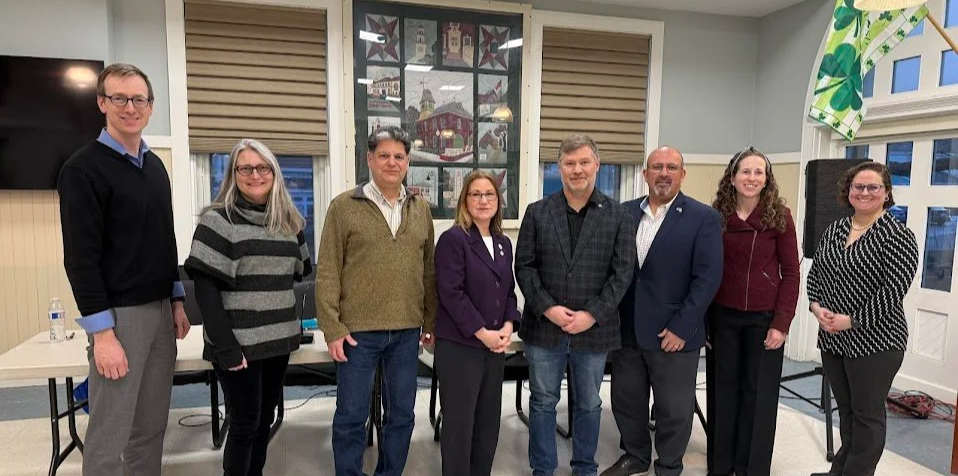
Select Board candidates and organizers at the candidate forum. Pictured (left to right): interviewers Tom Grant, Megan Fidler-Carey, candidates Tony D’Arezzo, Karen Herrick, Sal Bramante, Carlo Bacci, moderator Jen Hillery, and Reading Democratic Town Committee Chair Vanessa Alvarado. Photo by Taylor Gregory.
