Town Meeting Night 1 recap: April 27, 2026
(5-6 minute read)
For residents looking to stay up to date on key town matters, this recap highlights major takeaways from Town Meeting Night 1 held on Monday, April 27, 2026.
Watch the full meeting here on RCTV’s Youtube page.
Review the full Annual Town Meeting Warrant.
Review the full Annual Town Meeting Warrant Report.
Key takeaways
Town Meeting approved multiple financial and administrative articles to begin the night
Articles related to capital planning, budget transfers, revolving funds, stabilization funds, recreational land dedication, and Sunday brunch alcohol service all passed during the session.
The FY2027 operating budget was tabled until Night 2
Town Meeting voted to postpone discussion of Article 6, the Town’s FY2027 operating budget, until the following session.
Community Preservation Act discussion dominated the evening
Town Meeting spent significant time debating Article 13, which would place a Community Preservation Act (CPA) surcharge question before voters this November. After extended debate, the article passed 106-56.
Opening remarks and State of the Town [0:24:53]
Select Board Chair Melissa Murphy opened Town Meeting with a “state of the town” address, highlighting several major transitions and accomplishments over the past year.
Murphy acknowledged:
New Town Manager Jayne Wellman
New school leadership with Dr. Henry Turner coming in as Superintendent of Reading Public Schools
Outgoing Superintendent Dr. Tom Milaschewski’s contributions, including pathways programs, improved MCAS scores, and full-day kindergarten
The Town’s strong financial position, crediting Town Accountant and CFO Sharon Angstrom
Ongoing capital projects, including Killam School, Reading Center for Active Living (ReCAL), and pickleball courts
The creation of the new Commission on Disabilities
The arrival of new businesses in Reading
Article 4: Capital Improvements Program approved [0:34:07]
Town Meeting approved updates to the Town’s Capital Improvements Program under Article 4.
Financial adjustments include:
An additional $80,000 in FY26
A $65,000 reduction in FY27
More than $500,000 in FY28 adjustments and debt planning
Addition of a Water Master Plan within enterprise funding
Discussion included:
Replacement of outdated Reading Fire Department training equipment, including adult and infant training mannequins
Birch Meadow lighting replacement funding, and whether CPA funding could potentially support future projects
Insurance reimbursements related to lighting equipment replacement
Article 5: Budget transfer discussion [0:44:14]
Article 5 focused on budget adjustments and transfers across several departments.
Chief Financial Officer Sharon Angstrom outlined multiple contributing factors, including:
Increased OPED costs
High unemployment claims
Public safety overtime
Snow and ice expenditures exceeded budget projections by approximately $900,000
Attrition savings and returned educational funding balances
Police Chief David Clark explained that police overtime increases were driven in part by staffing shortages, military activations, and coverage for community events.
Town Meeting Members also raised concerns about winter sidewalk conditions near schools following multiple storms. Town Manager Jayne Wellman said the Town is exploring a collaboration with the School Department to develop a sidewalk shoveling program to improve pedestrian safety for students.
Articles 11 & 12: Pickleball land dedication and Sunday brunch alcohol service approved
Articles 11 and 12 both passed with limited debate.
Pickleball grant requirements [1:10:43]
Community Planning Director Andrew MacNichol explained that Article 11 was tied to a successful PARC grant application related to the Town’s pickleball project.
One condition of the grant required that the land be permanently dedicated to recreational use.
Town Meeting Members also discussed whether Reading residents could receive priority access for reservations. Staff explained that while preference cannot legally be given to residents, non-residents may be charged slightly higher fees.
Sunday brunch alcohol service [1:27:09]
Article 12 authorized earlier alcohol service during Sunday brunch hours at the request of several local restaurants.
The article received unanimous support from the Bylaw Committee before ultimately passing Town Meeting.
Article 13: Community Preservation Act sparks extended debate [1:31:16]
The longest and most detailed discussion of the night centered on Article 13, which sought Town Meeting approval to place a Community Preservation Act (CPA) question before voters in November 2026.
What the proposal would do
Finance Committee Chair Joe Carnahan explained that CPA is a 25-year-old state law allowing communities to create a dedicated funding source for:
Open space and recreation
Historic preservation
Affordable housing
The proposal recommended:
A 1% residential surcharge
Exemptions for commercial and industrial properties
Exemptions for low-income households and qualifying seniors
Exemptions for the first $100,000 of residential property value
Carnahan said approximately 201 Massachusetts communities have already adopted CPA.
Arguments in support
Supporters argued the program would:
Bring state matching funds back to Reading
Help fund recreation, housing, conservation, and historic projects
Reduce reliance on the general tax levy for qualifying capital projects
Examples of potentially eligible projects discussed include:
Mattera Cabin
Birch Meadow improvements
Maillet, Sommes, and Morgan conservation work
Affordable housing initiatives
Pleasant Street Center improvements
Several speakers emphasized that Town Meeting was not adopting CPA directly, but simply allowing voters to decide the question in November.
Concerns raised
Opponents and skeptical members focused heavily on affordability concerns and timing.
Key concerns included:
The financial impact of a future override related to Killam and ReCAL
Rising household costs
Concerns about adding another property tax surcharge during an already challenging fiscal period
Finance Committee member Marianne Downing said she supports the CPA conceptually, but questioned whether this was the right time, given expected override discussions later this year.
Other members questioned:
Whether state matching percentages could decline in the future
Whether CPA would replace or supplement existing capital spending
How projects would ultimately be selected and approved
Motion passed after lengthy debate
After nearly two hours of discussion, Town Meeting voted to move the question, followed by a roll call vote.
Article 13 ultimately passed 106-56, placing the CPA question on the November 2026 ballot for voters to decide.
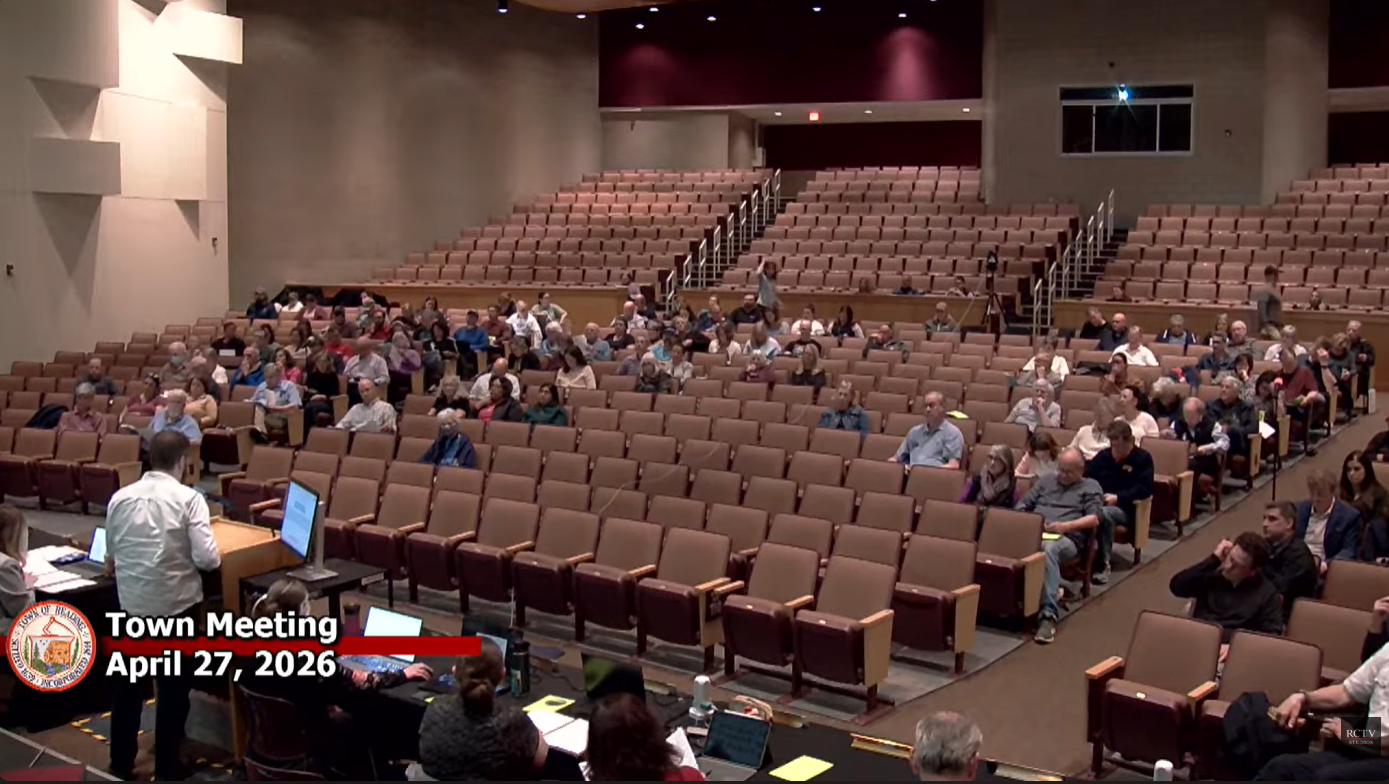
April 27, 2026: Town Meeting Night 1 in the Performing Arts Center at Reading Memorial High School. Photo from the RCTV Youtube page.
