Town Meeting Night 3 recap: May 4, 2026
(5-6 minute read)
For residents looking to stay up to date on key town matters, this recap highlights major takeaways from the Select Board meeting held on Monday, May 4, 2026.
Watch the full meeting here on RCTV’s Youtube page.
Review the full Annual Town Meeting Warrant.
Review the full Annual Town Meeting Warrant Report.
Key takeaways
Town Meeting overwhelmingly supported expanding adaptive and Unified Sports programming, with many speakers sharing emotional personal stories about the impact of inclusion and accessibility programs.
Much of the debate centered not on the value of the programs themselves, but on whether Burbank Ice Arena's lease revenue should be partially dedicated to stabilization funds supporting the programs.
After extensive debate, Town Meeting approved Article 14 by a decisive 126-29 roll-call vote, following an earlier amendment requiring 25% of lease payments to be directed to each stabilization fund.
Article 14: Stabilization funds for adaptive programming
Article 14 proposed creating stabilization funds supported by a portion of the Burbank Ice Arena lease revenue to help fund adaptive sports (AS) and Unified Sports (US) programming in Reading. The discussion became the evening’s longest and most emotional debate.
Town Manager Jayne Wellman opened with background on how the proposal developed, explaining that conversations began following a May 2025 instructional motion from Town Meeting Member Eric Gaffen and continued through discussions between Town and school officials in 2025.
Wellman explained that the original stabilization structure evolved from one fund into two separate funds, one supporting schools and another supporting therapeutic programming, with the intent of creating a sustainable community asset without increasing tax burdens.
Unified Sports presentation highlights growth and inclusion
Reading Public Schools Unified Sports Coordinator Tara Herlihy gave an in-depth presentation on the program's growth and impact.
Herlihy described US as a program designed for “everyone,” bringing together students with and without disabilities, including varsity athletes, to promote inclusion, belonging, and lifelong healthy activity.
The program began in 2004 under the Special Olympics umbrella with just five students and a van. Since then, it has evolved significantly, especially following a post-COVID transition toward Reading’s “Unified Sports Day” model.
Current participation now includes approximately 120 students across grades K-12 through basketball, strength and conditioning, and other seasonal programming.
Future goals discussed included:
Expanded middle school programming
Additional adaptive and inclusive opportunities
Updated uniforms and equipment
Increased elementary-level inclusion activities
Community-wide events such as a Unified Walk/5K
Debate shifts to funding structure
While speakers overwhelmingly praised the AS and US programs themselves, disagreements emerged over whether fluctuating Burbank lease revenue was an appropriate long-term funding source.
Finance Committee (FinCom) member Ed Ross noted FinCom had already added $25,000 to the school budget for AS and US, but warned that stabilization funds may create inconsistent or uncertain funding streams.
Multiple Town Meeting Members expressed concern that:
Burbank lease payments fluctuate significantly year to year
Stabilization funds are typically used differently
The structure could create precedent for earmarking revenue for specific groups or programs
Programs might struggle if the future lease revenue declines
Others countered that the stabilization funds would serve as a starting point and not the sole funding source for the program.
Wellman emphasized several times that the proposal did not guarantee or dedicate all lease revenue to AS and US programming, noting that Town Meeting would still control appropriations annually.
Personal stories highlighted the importance of inclusion
Some of the evening’s most impactful moments came from parents and advocates who shared personal experiences about the challenges families face in finding adaptive and inclusive programs.
Several speakers described how limited recreation opportunities can leave children with disabilities feeling isolated or excluded from activities that many other students take for granted. Others spoke about the emotional impact of seeing students finally have the chance to participate alongside their peers through AS and US programming.
Parents also noted that many families currently travel to other communities or face waitlists to access similar programs, while others emphasized the importance of creating opportunities for students to build friendships, confidence, and a sense of belonging within Reading.
Supporters argued that while the funding mechanism may not be perfect, the programs themselves have already demonstrated a meaningful impact on students and families throughout the community.
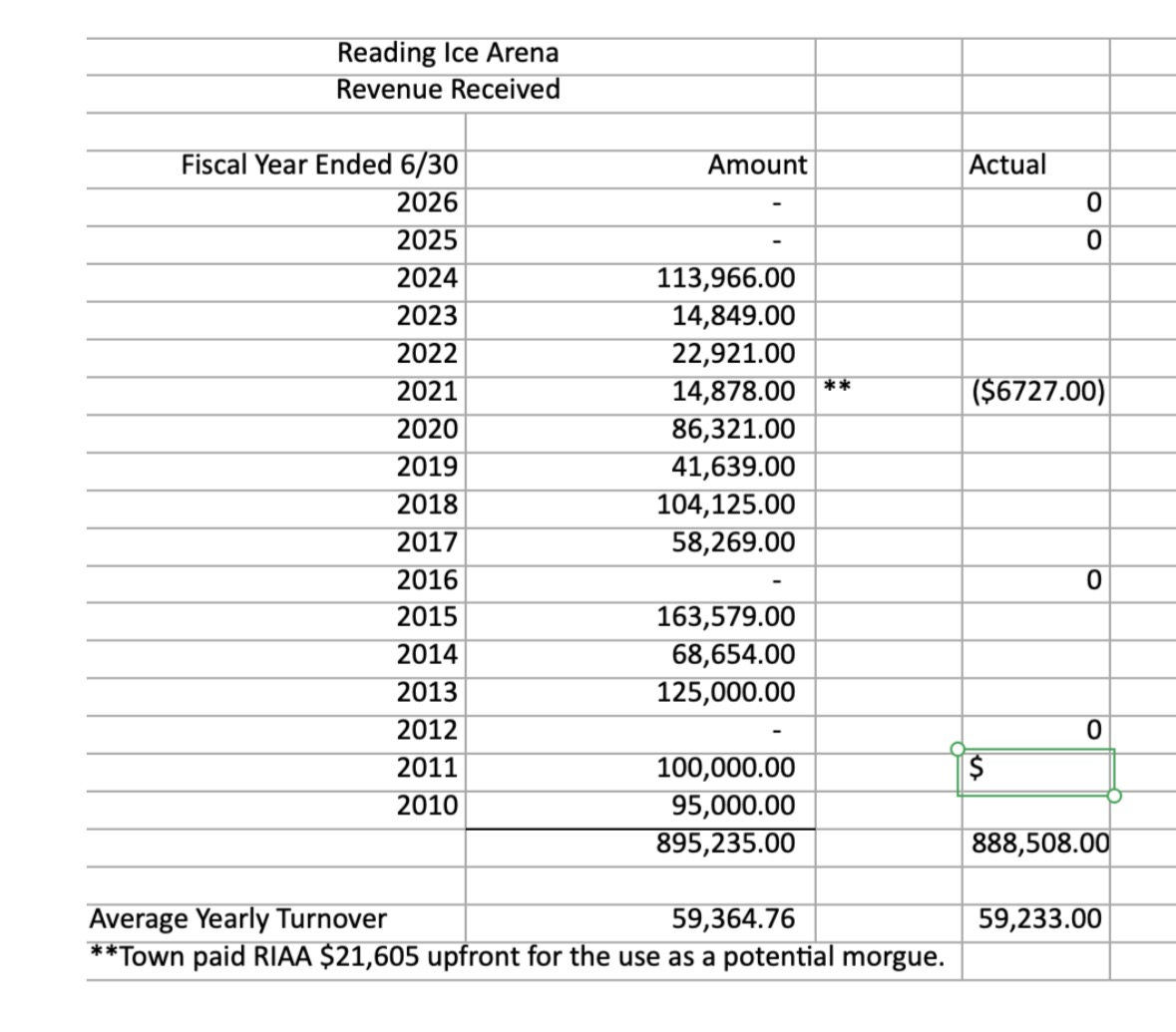
Table outlining annual Burbank lease payments to the Town of Reading from 2010 through 2026, referenced during discussion of proposed stabilization funding for AS and US programming.
Concerns raised over Burbank lease revenue
Other speakers remained focused on governance and budgeting concerns.
Several Town Meeting Members all voiced support for the programs themselves while opposing the proposed funding mechanism.
Questions raised about:
Whether Burbank's revenue payments should remain unrestricted general revenue
Whether the lease payments are reliable enough to sustain programs
Whether the proposal gives too much influence to the Burbank negotiations
Why the programs were not instead funded directly through the operating budget
Town Counsel Ivria Fried clarified that state law requires stabilization funds to designate a percentage allocation and explained that the fund could later be rescinded or modified by Town Meeting after three years.
Amendment approved before final vote
During the debate, an amendment was proposed that would specify that 25% of lease payments could be directed to each stabilization fund, with the remaining 50% going to the general fund.
The amendment passed 91-63 following additional debate about whether to revise percentages aligned with the article’s intent.
Town Meeting later rejected an initial motion to end debate before ultimately voting again to close debate.
Article overwhelmingly passes
Following nearly three hours of discussion, Town Meeting approved Article 14 by a roll call vote of 126-29.
The debate revealed broad community support for AS and US programming, even among members who opposed the funding structure itself.
For many participants, the discussion became a broader conversation about inclusion, budgeting priorities, and how Reading chooses to support its most vulnerable residents.
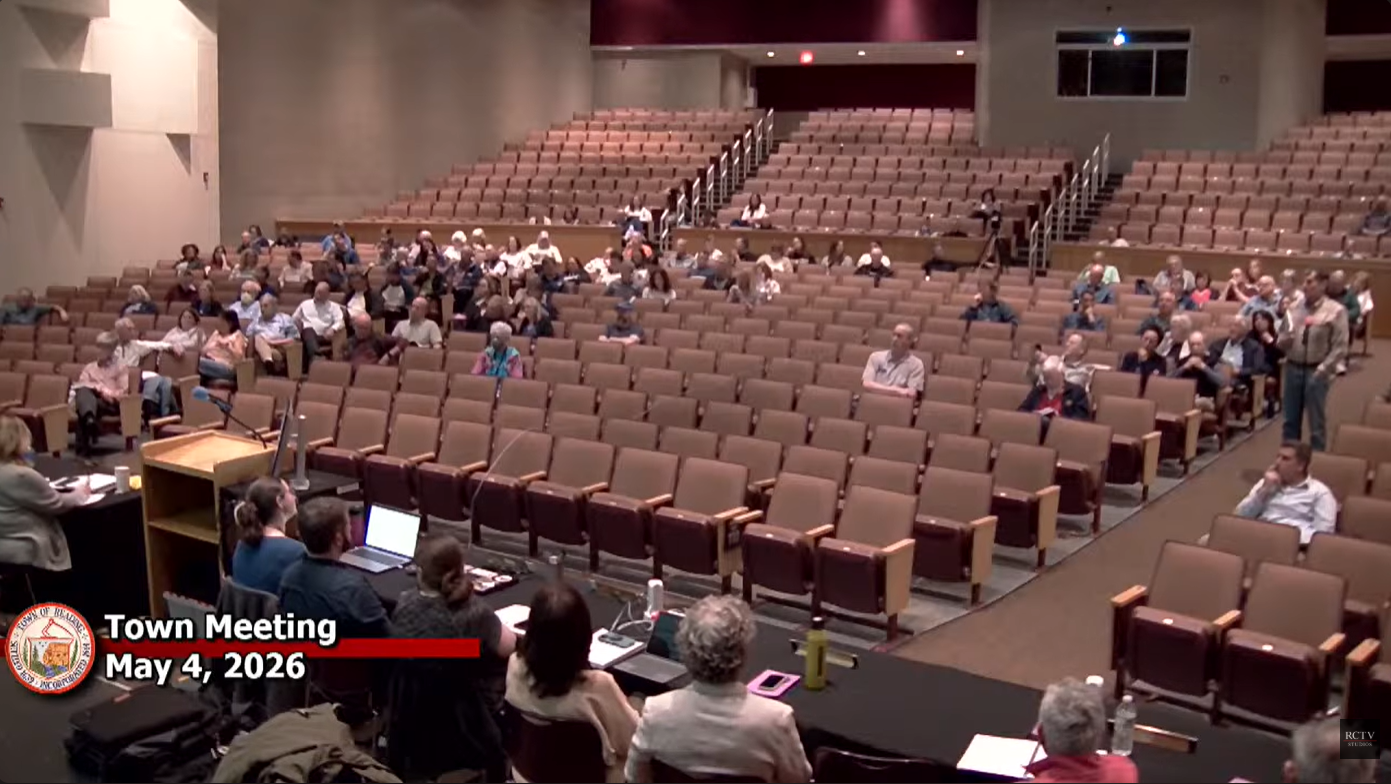
May 4, 2026: Town Meeting Night 3 in the Performing Arts Center at Reading Memorial High School. Photo from the RCTV Youtube page.
