Community Preservation Act: what’s on the November ballot
(4-5 minute read)
On November 3, 2026, Reading voters will decide whether to adopt the Community Preservation Act (CPA), a dedicated funding source for open space, historic preservation, and affordable housing that roughly two-thirds of Massachusetts communities have already adopted. The article draws on the CPA Study Committee’s February 2026 findings and recommendations, as well as its presentation to Town Meeting in April 2026, where the question was approved for the ballot.
Key takeaways
Voters decide on November 3 whether to adopt a 1% CPA property tax surcharge, projected to raise roughly $1.1M a year (local revenue plus a state match), dedicated exclusively to open space and recreation, historic preservation, and affordable housing.
Exemptions cover the first $100,000 of residential property value, commercial and industrial property, and low-income and low- to moderate-income seniors; the average homeowner would pay roughly $95-$102 per year.
Town Meeting voted 106-56 in April to place the question on the November ballot. The Select Board didn’t oppose it outright, but flagged timing concerns, given the Killam/ReCAL debt already on tax bills and a possible operating override also headed to voters this fall.
What is CPA?
The Community Preservation Act is a state law that allows Massachusetts cities and towns to adopt a local property tax surcharge of 0.5% to 3%, with revenue legally restricted to three categories: open space & recreation, historic preservation, and affordable housing. Communities that adopt CPA also become eligible for an annual distribution from the statewide CPA Trust Fund, which is seeded by a surcharge on fees collected at the Registry of Deeds. As of the committee’s report, 201 of Massachusetts’ 351 municipalities have adopted CPA. Reading has not, despite contributing to that statewide trust fund since 2003 through home-sale fees, received any money back.
What’s being proposed in Reading
The CPA Study Committee recommended a 1% surcharge. Based on the current assessed value, that would generate an estimated $1M in local revenue annually; combined with an expected state match of roughly $130,000 (based on the state’s most recent match rate of about 17%, which fluctuates from year to year), total annual CPA funding would run around $1.1M.
The proposal includes several exemptions: the first $100,000 of a residential property’s assessed value, all commercial and industrial property, and low-income residents and low- to moderate-income seniors. After exemptions, the average Reading homeowner would pay an estimated $102 a year (slide 13 of the presentation).
The case for adoption
The CPA Study Committee’s recommendation rests on two main points. First, CPA funding would free up general fund dollars currently spent on CPA-eligible work; the town already spends roughly $1M a year on projects like trail maintenance, invasive species removal, playground upgrades, cemetery restoration, and historic building preservation, all of which would shift to a dedicated CPA fund instead of competing with the operating budget. Second, adopting CPA would finally allow Reading to draw down state matching funds: the town’s homeowners have been paying into the statewide CPA Trust Fund since 2003 through Registry of Deeds fees, without ever receiving a share back, because Reading itself hasn’t adopted the act.
It’s a bit like shopping for years at a store with a rewards program and never signing up for the card; you’re still paying full price on every purchase while your neighbors check out with points, cashback, and member discounts on the same items. Reading residents have been contributing to the statewide CPA program’s reward pool since 2003 without ever swiping the card themselves. Adopting CPA is how the town finally starts redeeming what it’s already paid into.
Supporters also point to a less direct but frequently cited benefit: communities that invest consistently in open space, recreation, and historic character tend to see it reflected in property values, since a well-preserved, vibrant town is part of what makes a community desirable to live in. It’s a harder figure to pin down than a tax rate, but it’s part of why CPA has found support in comparable suburban communities across the state.
Specific projects mentioned during the April Town Meeting presentation as examples of the kind of work CPA dollars could support include restoration of the Mattera Cabin, improvements at Birch Meadow, conservation work at Maillet, Sommes, and Morgan, affordable housing initiatives, and upgrades at the Pleasant Street Center. Though no CPA committee or project list yet exists, that structure would only be established if voters approve the surcharge.
Concerns raised
The Select Board praised the quality of the committee’s report on February 10, 2026, but raised questions about timing rather than the merits of the CPA itself. Board members noted that Reading already has two debt exclusions on tax bills tied to the Killam School and Reading Center for Active Living (ReCAL) projects, with a separate operating override also on the November ballot, raising concern about how much additional tax burden residents can absorb at once, even if CPA’s roughly $100 annual cost is modest by comparison. Some members also questioned whether CPA funds would genuinely free up general fund spending as intended, or simply add to the town’s overall spending without offsetting existing budgets. Town Meeting ultimately voted 106-56 in April to send the question to the ballot; see our Town Meeting Night 1 recap for the full debate.
Statewide track record
Since CPA’s adoption in 2003, participating Massachusetts communities have raised more than $3.7M for local preservation work. Statewide, that funding has helped create more than 15,6000 affordable housing units (with another 21,000 supported), preserve 39,860 acres of open space, fund over 8,100 historic preservation appropriations, and launch more than 4,400 outdoor recreation projects.
What happens next
If voters approve the question on November 3, Reading would establish a local CPA Committee to evaluate and recommend projects funded by the new surcharge. A local advocacy group, Yes for CPA for Reading, has organized in support of the ballot question ahead of the vote.
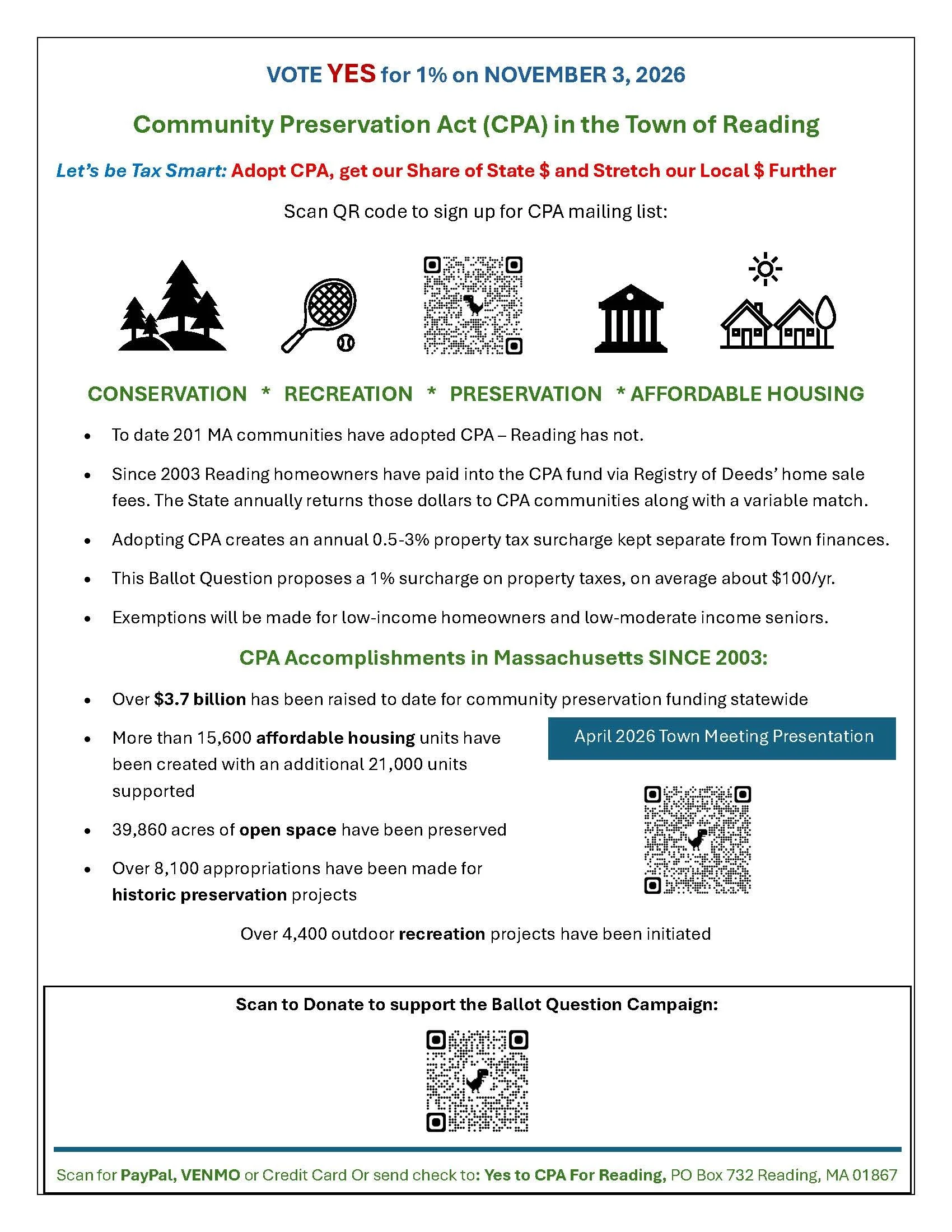
Flyer provided by Yes for CPA for Reading.
