(3-4 minute read)
Reading Memorial High School moved up 10 spots in Boston Magazine’s newly released 2026-2027 rankings of the best public high schools in Greater Boston, landing at No. 52 out of 148 schools evaluated, up from No. 62 last year. The ranking draws on data from the Massachusetts Department of Elementary and Secondary Education (DESE) and local housing costs.
How the rankings work
Boston Magazine’s methodology ranks public high schools within or partially within Route 495, using DESE data on MCAS and SAT scores, AP proficiency, graduation rates, teacher evaluations, and access to arts and computer science courses. Charter and other highly specialized schools are excluded, and when data were missing for a school, equal weight was given to the available categories. The rankings favor smaller class sizes and lower student-to-teacher ratios. The methodology also factors in each school’s local median home price, sources from the Massachusetts Association of Realtors and the MLS Property Information Network, along with median household income; for schools serving multiple cities or towns, the magazine used a weighted average of those figures.
RMHS by the numbers
RMHS’s enrollment stands at 1,066 students, with an average class size of 15.2 and a student-to-teacher ratio of 11.6-to-1. On the 2025 MCAS, 68% of 10th graders met or exceeded expectations in English Language Arts, 63% in Math, and 58% in Science, Technology, and Engineering. Average SAT scores were 589 for reading and writing and 586 for math. The school reported an 83% AP exam pass rate, a 98.5% graduation rate, and 100% of educators rated proficient or exemplary in evaluations. Boston Magazine also tracked access metrics: 52.7% of students have access to arts courses, 22.7% have access to digital literacy and computer science courses, and 69.8% have completed advanced coursework. For Reading, the magazine listed a median home price of $901,500, a median household income of $165,912, and a town population of 25,803.
A ranking that’s moved around
RMHS’s position in Boston Magazine’s rankings has shifted considerably over the past several years: No. 50 in 2021, No. 60 in 2022, No. 51 in 2023, No. 62 in 2024, and No. 62 again in 2025 before this year’s rise to No. 52.
What’s at stake this November
The metrics behind Boston Magazine’s ranking (class size, student-to-teacher ratios, MCAS and SAT performance, and access to advanced coursework) are the same ones town and school officials have pointed to throughout Reading’s public conversations about the proposed FY28 Proposition 2 ½ override, which goes before voters in November. At the August 6 override webinar and subsequent sessions, school leaders presented a chart tracking per-pupil spending from 2020 to 2024 across Reading and five comparable communities (see below). Reading’s per-pupil spending rose from about $15,300 in 2020 to about $20,100 in 2024, below the state average, which climbed from roughly $17,600 to $23,200 over the same period, and below four of the five other districts shown: Wilmington (about $19,000 to $25,800), Marblehead (about $17,800 to $22,000), Wakefield (about $16,800 to $20,700), and Lynnfield (about $16,600 to $20,600). Only Melrose, which rose from about $12,700 to $17,00, spent less per pupil than Reading throughout that period. Officials pointed to that gap as evidence that recent investments, added assistant principals and adjustment counselors, expanded Advanced Placement participation, and career-pathways programs, were designed to improve student outcomes without driving up costs relative to neighboring districts.
Officials have said that without the override, the district would need to cut positions, including educators and paraprofessionals, which would increase class size and student-to-staff ratios district-wide. School leaders have also argued that fewer staff available to intervene early could mean more students eventually requiring formal accommodations, potentially increasing costs down the line, including out-of-district special education placements, which officials have said can range from $65,000 to $400,000 per student.
Boston Magazine’s ranking also weighs local home prices, an area where Town Manager Jayne Wellman and other officials have tied school quality directly to property values. Reading’s’s median home price in this year’s ranking, $901,500, is one factor the magazine’s methodology incorporates alongside academic performance.
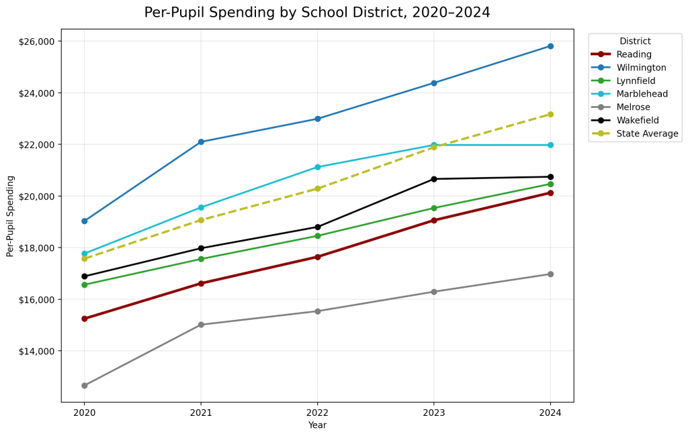
Reading’s per-pupil spending has trailed both the state average and four of five comparable communities from 2020 to 2024, with only Melrose spending less. Graph from the August 6, 2026 Override Webinar presentation slides.
