(8-minute read)
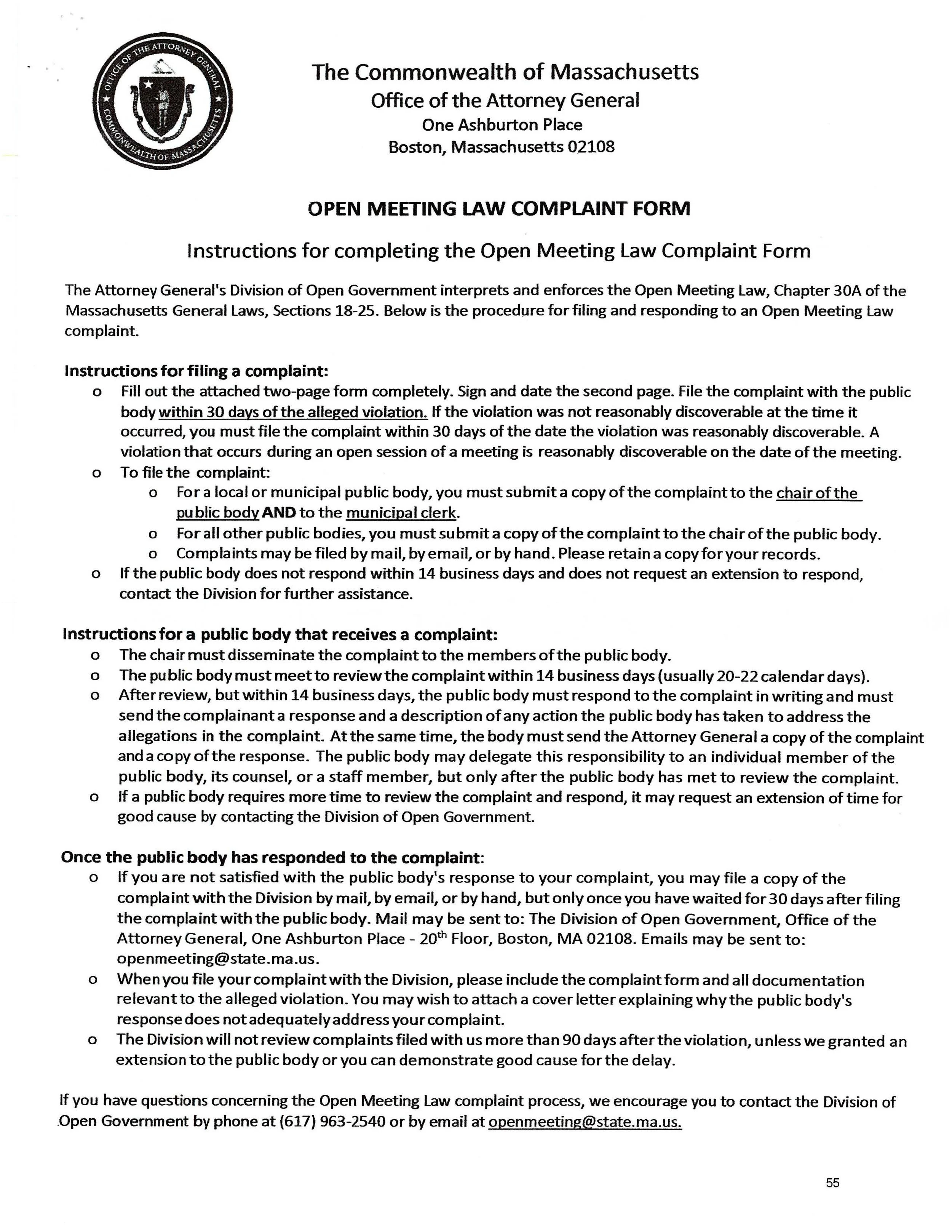
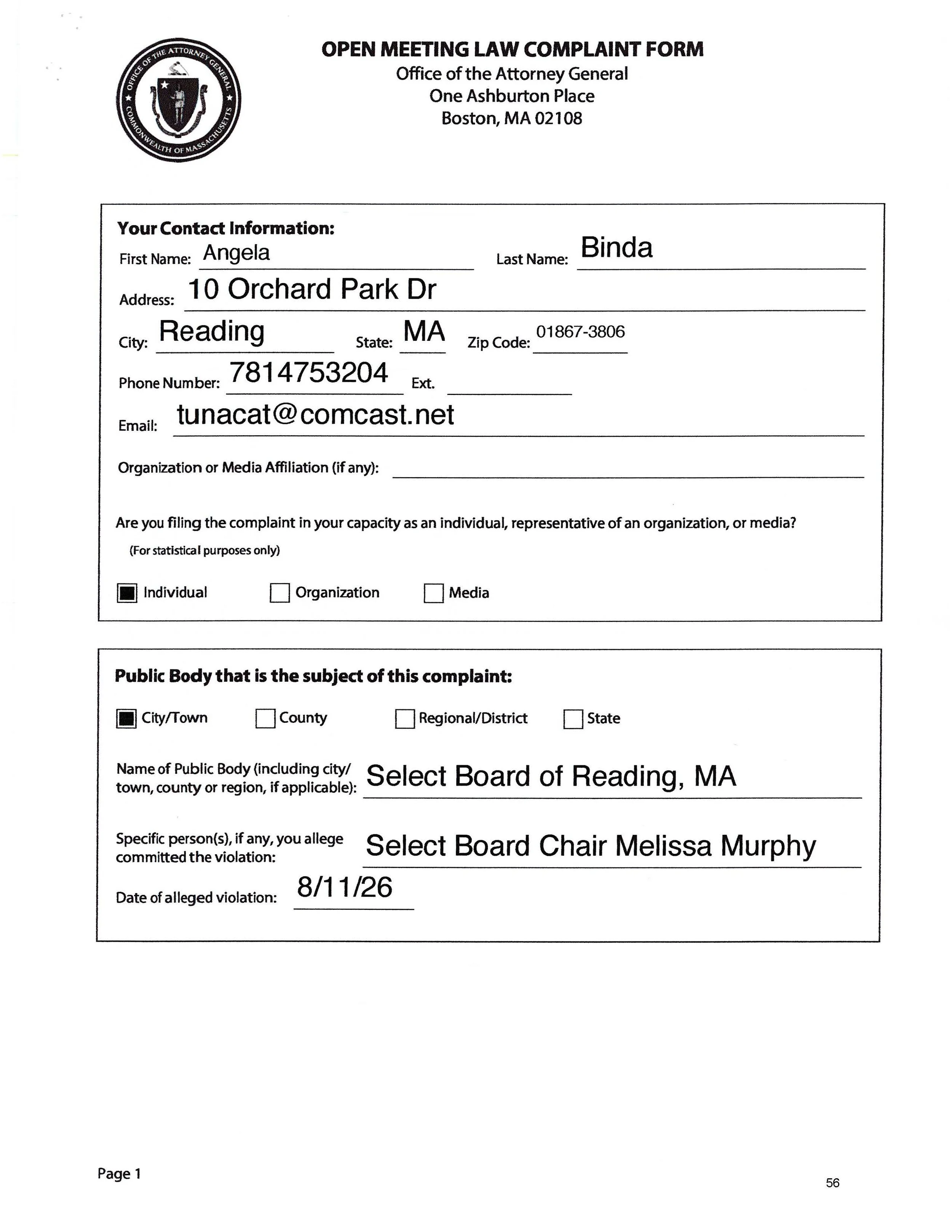
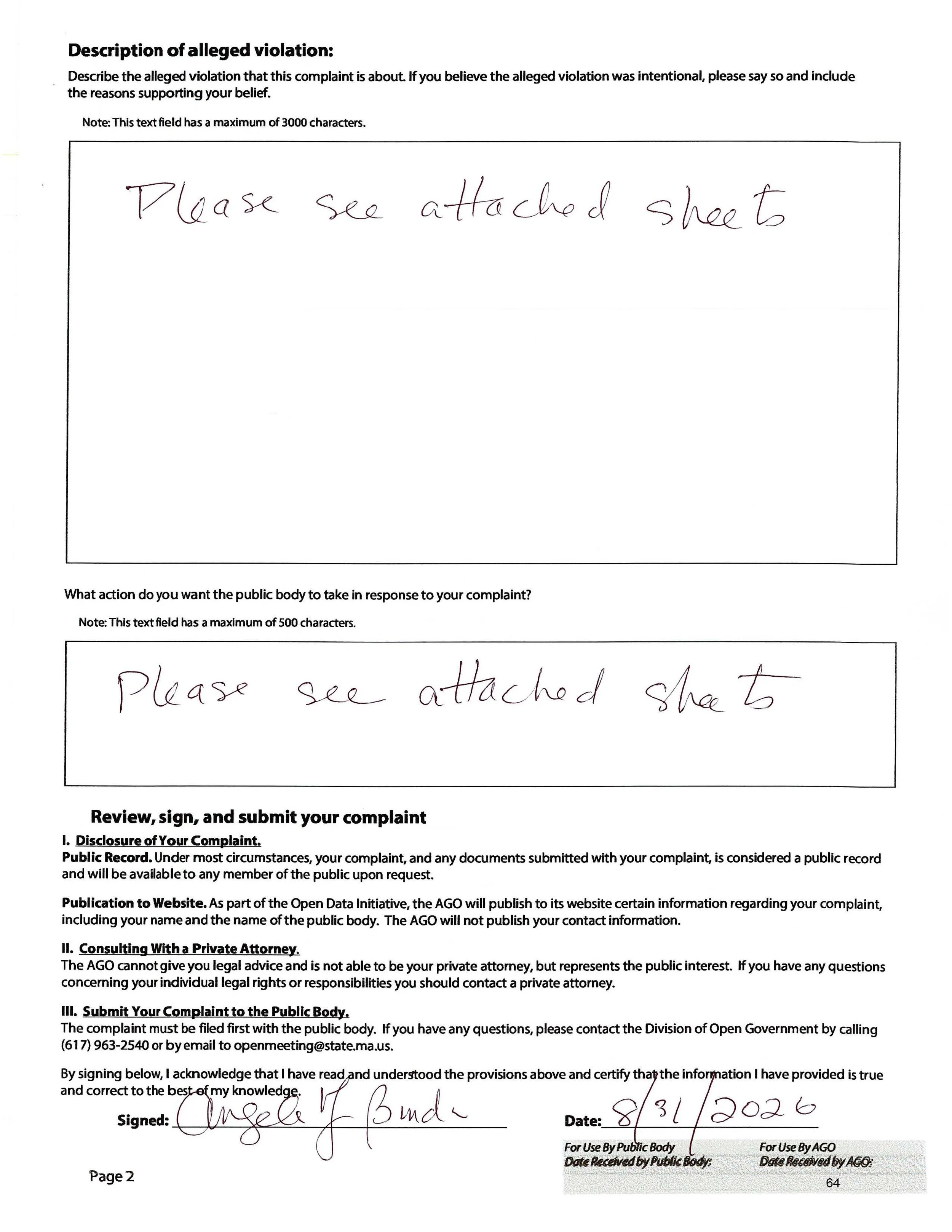
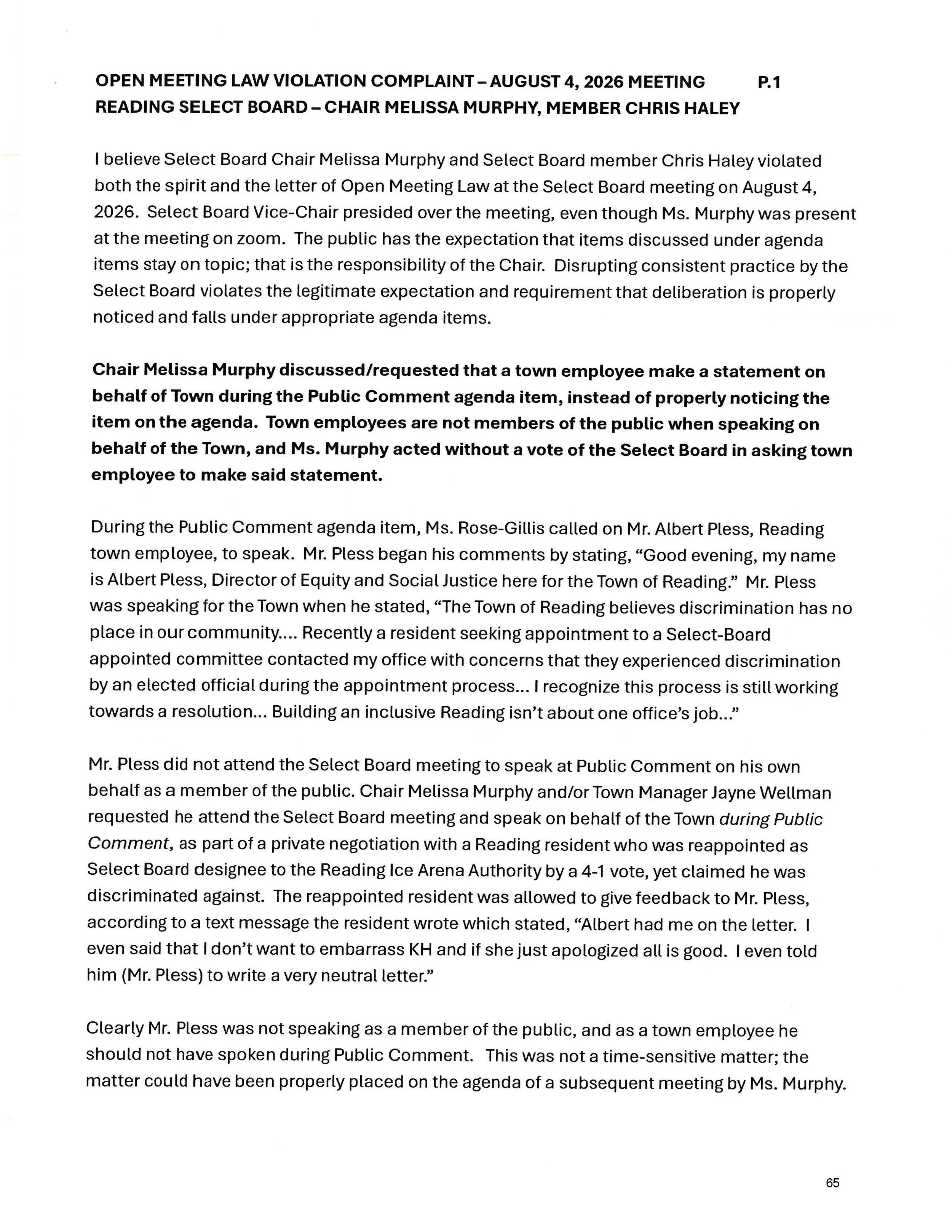
Reading resident Angela Binda has filed two Open Meeting Law complaints against members of the Select Board, and both are scheduled to be discussed in executive session when the Board meets tonight, September 8, at Town Hall. One targets an email sent under Chair Melissa Murphy’s name. The other accuses Murphy and member Chris Haley of violating the law during the public comment period of the Board’s August 4 meeting.
An email from the Chair
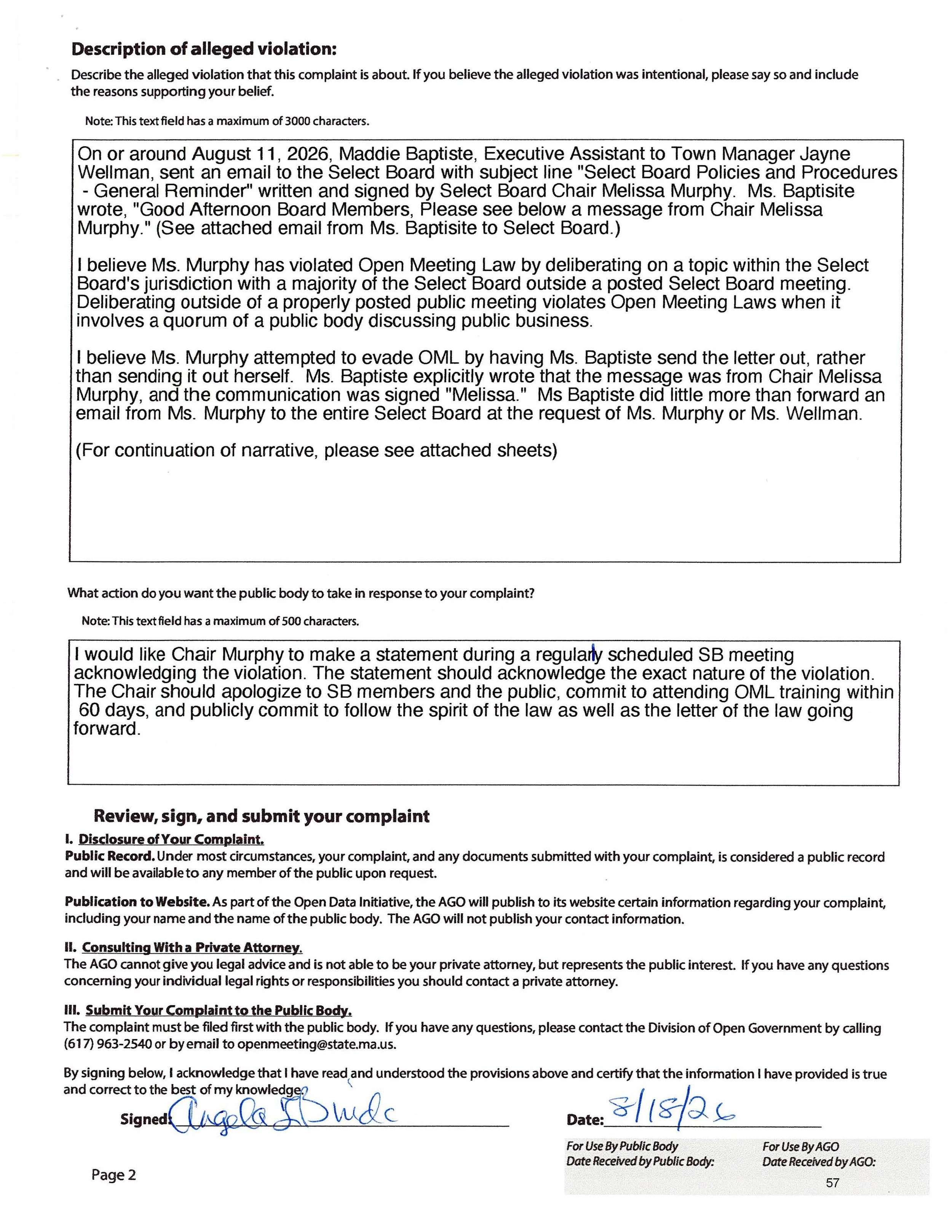
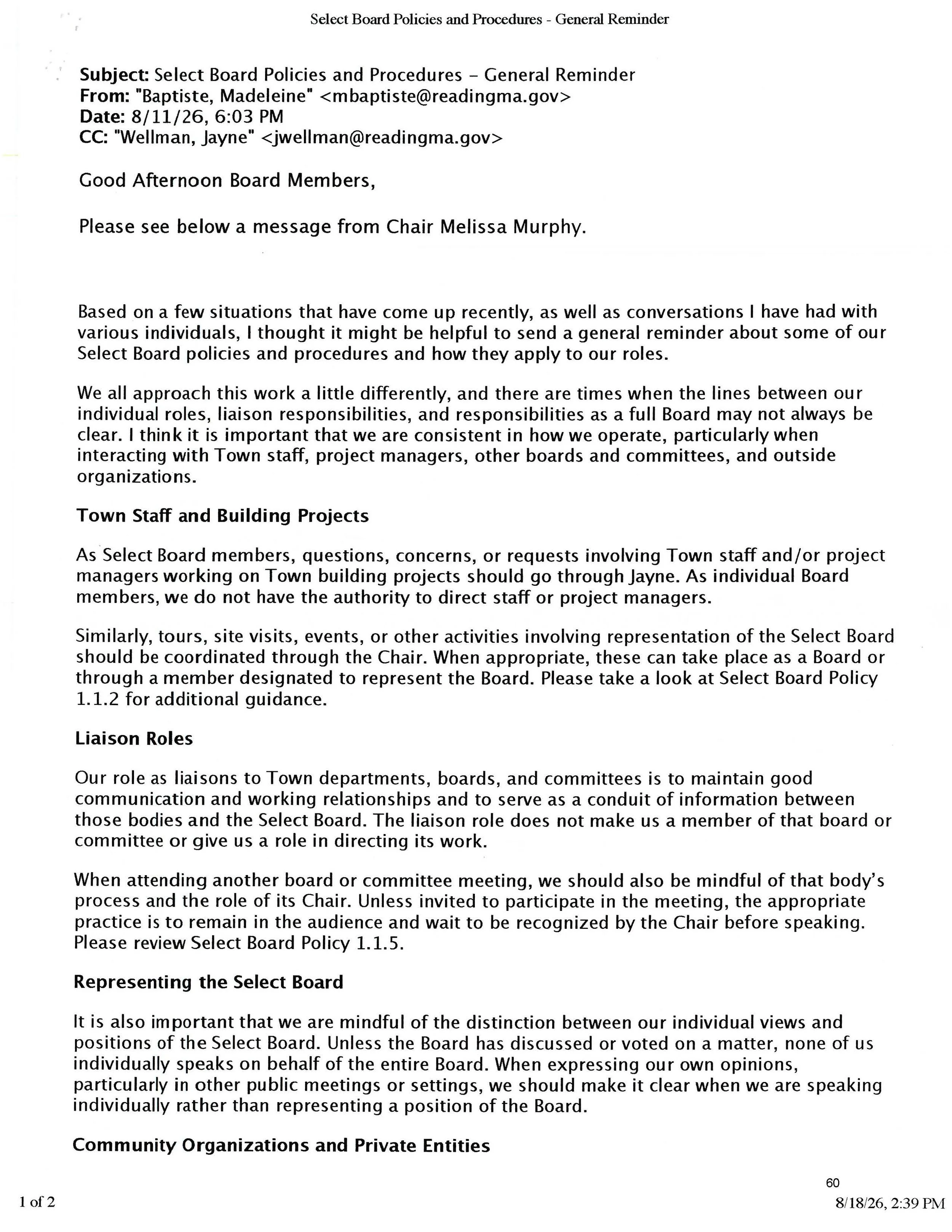
Binda’s first complaint takes issue with an email sent to the full Select Board on August 11 by Maddie Baptiste, executive assistant to Town Manager Jayne Wellman. The email, titled “Select Board Policies and Procedures - General Reminder,” was written and signed by Murphy but sent through Baptiste, with Wellman copied.
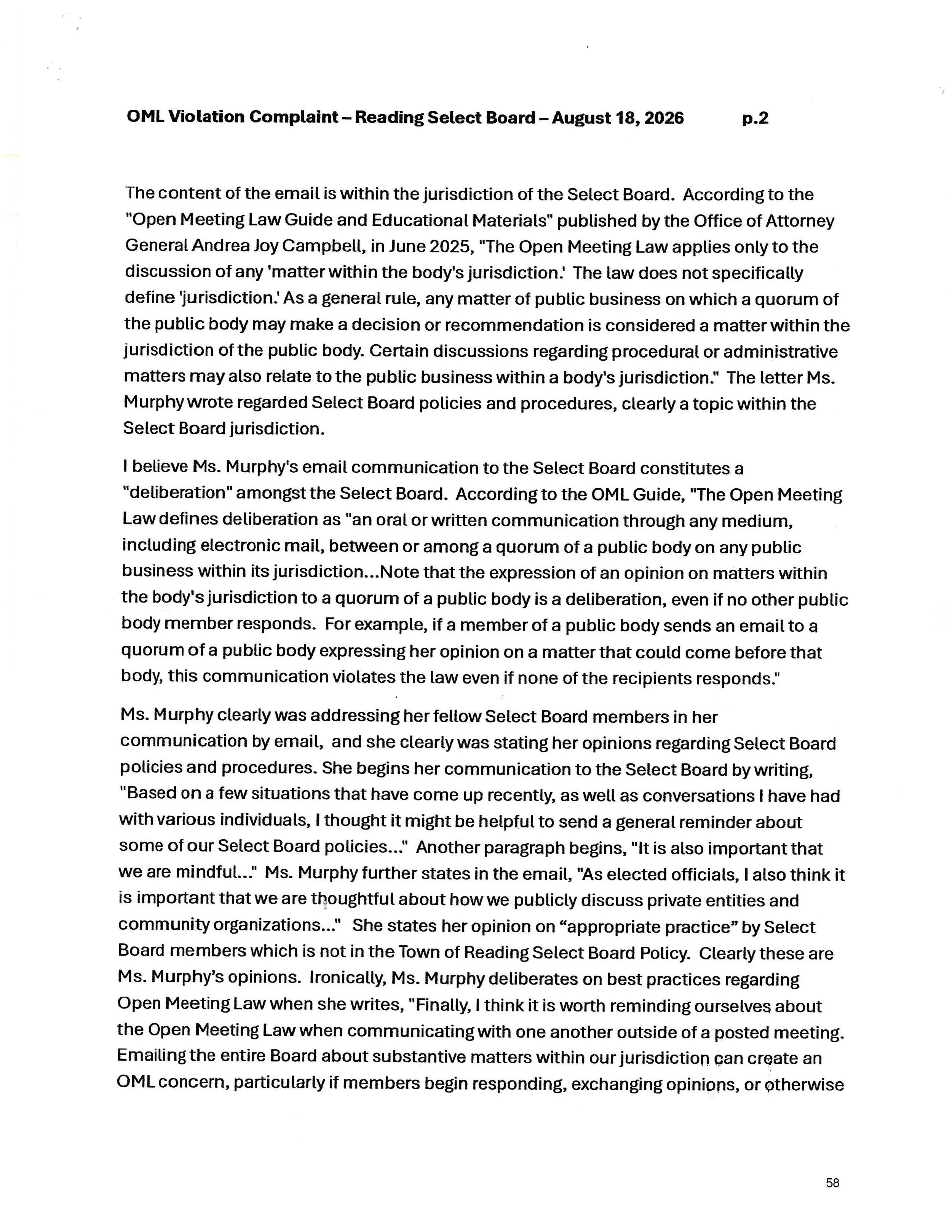
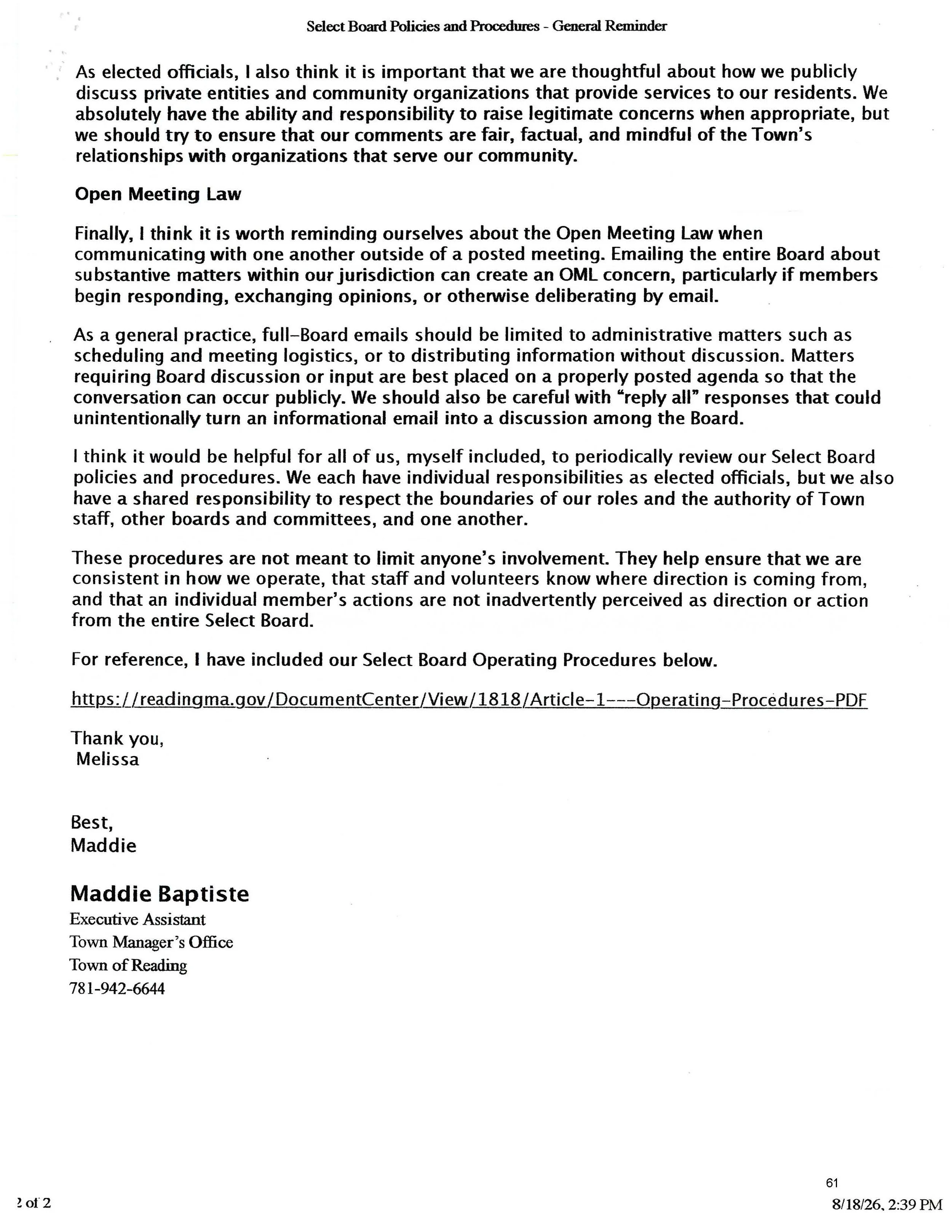
In the email, Murphy reminded her colleagues to route requests involving town staff and building projects through Wellman, to be mindful of the line between individual opinions and the full Board's positions, and to be careful when discussing private entities and community organizations. Murphy also raised the Open Meeting Law itself, writing that emailing the entire board about “substantive matters within our jurisdiction can create an OML concern, particularly if members begin responding, exchanging opinions, or otherwise deliberating by mail.”
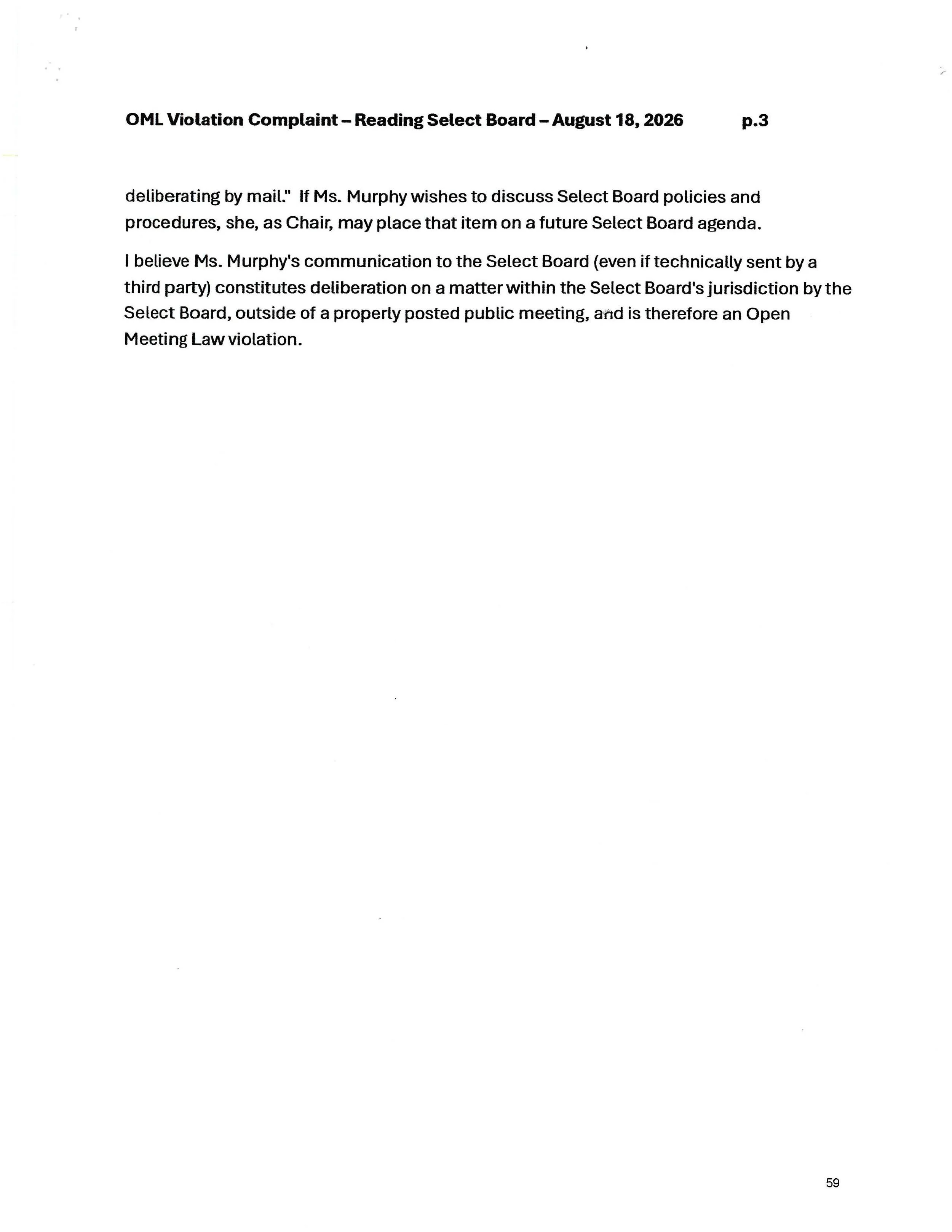
Binda’s complaint argues that the email itself was the violation. She wrote that the message constituted a “deliberation” among a quorum of the Board on a matter within its jurisdiction, since it addressed Select Board policy and procedure and was communicated to every member outside a posted meeting. Under the Attorney General’s Open Meeting Law guidance, a communication can qualify as deliberation even when no other board member responds. Binda also wrote that she believes Murphy tried to evade the law by having Baptiste distribute the email rather than sending it herself, noting that Baptiste explicitly identified the message as coming from Murphy and that it was signed “Melissa.”
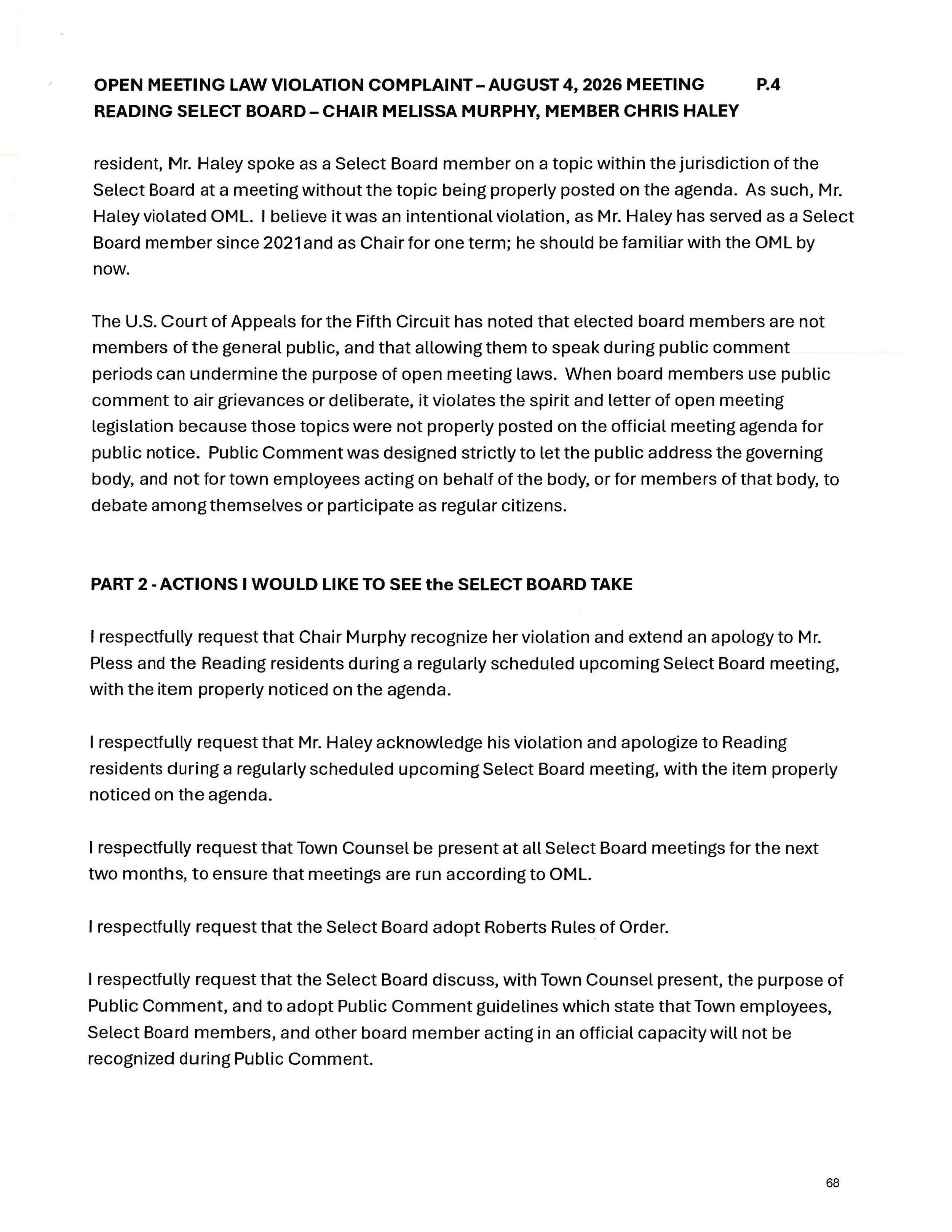
Binda is asking that Murphy acknowledge the violation at a posted Select Board meeting, apologize to the Board and the public, commit to Open Meeting Law training within 60 days, and commit to following the law going forward.
Public comment and setting agendas
A second complaint centers on the Board’s August 4 meeting, when Vice Chair Karen Rose-Gillis recognized Albert Pless, the town’s Director of Equity and Social Justice, who told the Board that a resident had contacted his office believing they had experienced discrimination during a Select Board appointment process, and that his office was working toward a resolution. Binda’s complaint alleges that Pless was speaking on behalf of the town rather than as a private resident, and that he appeared at Murphy’s or Wellman’s request as part of a private negotiation with the resident involved, rather than under a properly posted agenda item. The complaint argues that a Select Board member has no individual authority to direct a town employee to appear before the Board, and that Murphy, as Chair, was responsible for keeping that discussion off of public comment and on a posted agenda instead.
The complaint separately points to comments Murphy made at the Board’s July 14 meeting, when she raised the same appointment matter outside any posted agenda item, telling the audience, “It’s not on our agenda,” when member Karen Herrick asked her to elaborate. The complaint states that the 30-day window to file over that meeting has already passed, but cites it as an earlier example of the same conduct.
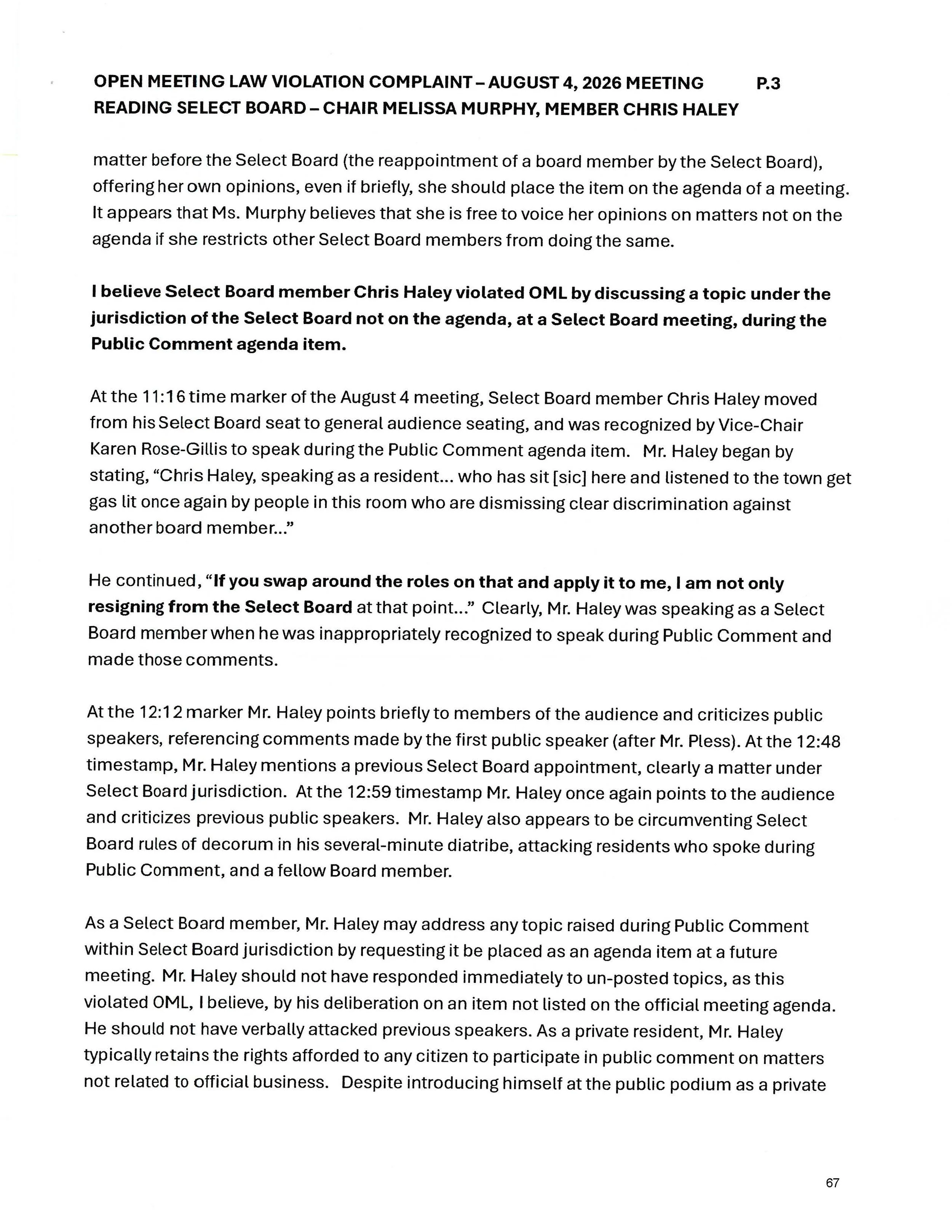
The complaint also addresses Haley, who left his seat on the dais to speak from the audience microphone during public comment, introducing himself as “a resident” before criticizing the handling of the discrimination complaint and yelling at a previous public speaker. Binda’s complaint argues that Haley was speaking as a Board member on a matter within the Board's jurisdiction, not as a private citizen, and that any response he wished to make belongs on a future agenda rather than in the middle of public comment.
Binda is asking that both Murphy and Haley acknowledge their violations and apologize to residents at a posted meeting, that Town Counsel attend every Select Board meeting for the next two months, that the Board adopt Robert’s Rules of Order, and that the Board work with Town Counsel to adopt public comment guidelines barring town employees and Board members from being recognized to speak in an official capacity during that portion of the meeting.
How the Board has handled OML complaints before
Tuesday’s meeting will be the third time since 2024 that the Select Board has had to publicly respond to an Open Meeting Law complaint, and the two earlier cases set a precedent.
A complaint filed by Bill Brown on February 17, 2024, was placed on the agenda as both an open and executive session item, at the very start of the meeting, with the complaint itself included in that night’s packet. When it came time to vote on entering executive session, Haley objected, arguing that the Board should stay in open session given the public’s loss of trust following a colleague’s resignation at the prior meeting. Then-member Mark Dockser countered that entering executive session to review the complaint with counsel and then returning to open session to respond publicly reflected the Board’s established practice, and that state law required a written response within 14 days regardless. Member Karen Herrick agreed, saying the Board had been fortunate not to have faced an Open Meeting Law complaint in her time on the Board since 2020, and that the Board would return to the public with its findings. Haley maintained he was being consistent, noting he had voted against entering executive session in the past except for matters like collective bargaining, and said he had “nothing to hide.” The vote to enter executive session failed 2-2, with Dockser and Herrick in favor and then-member Carlo Bacci and Haley opposed, and the Board instead discussed the complaint in open session.
A complaint filed by Dan Dewar on June 4, 2024, followed a similar path, appearing as the first agenda item with the option of open or executive session, but with an unusual addition: a proposal to invite one of the residents named in the complaint into executive session to discuss it. Town Counsel Ivria Fried and members debated the propriety of the arrangement. Herrick argued for handling the matter in open session instead, telling colleagues, “If we are going to invite a member of the public, then all of the public should be invited.” Dockser called the proposed arrangement unlike anything he had experienced. Murphy noted that involving a private resident in an executive session tied to an Open Meeting Law complaint was a new situation for the Board. The vote to enter executive session passed 3-1-1, with Herrick abstaining as the subject of the complaint, Dockser opposing, and Bacci, Haley, and Murphy in favor. In that case, the Board issued its written response without further discussion in open session.
A complaint handled differently this time
The most recent complaints follow a different path from either of those precedents. Both are being taken up together under a single executive session item, which is the very last item on Tuesday’s agenda, scheduled for 8:35 pm, after public comment, the override discussion, liaison reports, and future agendas have all been addressed. The complaint documents themselves sit at the very end of the 68-page packet, on the last fourteen pages. And while the 2024 complaints were included in their packets from the moment those packets were first posted, the documents related to the recent complaints were not part of the September 8 packet when it was originally published on Friday, September 5. They were added on the day of the meeting, meaning residents who checked the agenda and packet over the Labor Day weekend would not have seen them.
The Board’s own draft motion for Tuesday goes further than either 2024 case: it directs the Board to enter executive session with town staff and counsel “to discuss Open Meeting Law complaints filed against the Select Board by Angela Binda, and to not reconvene in open session after the executive session.” That would mean no public discussion of either complaint, with the Board also declining further open-session discussion, and a more closed approach than with the 2024 Brown complaint, where a tied vote kept the whole discussion in open session.
Taken together, the timing of the complaint’s addition to the packet, its placement at the very end of the agenda, and a draft motion that forecloses any public discussion mean residents are less likely to hear the Board address these allegations directly than they were in 2024, even as the underlying dispute, over the same August 4 public comment period, has already drawn scrutiny over the tone of the discussion.
Given that at least one of the two prior complaints was resolved through discussion in open session, residents may want to ask the Board to discuss Tuesday’s complaints in open session as well, rather than relying on executive session minutes, which are released only after they have been reviewed and modified by the Board and Town Counsel.