Reading Police urge riders to know the rules for e-bikes and similar
(2-minute read)
The Reading Police Department is asking riders, and especially parents of younger riders, to understand what they are operating and the laws that apply, as electric bikes, mopeds, motorized bicycles, and electric motorcycles grow more common on the town’s roads.
Many of these vehicles can reach significant speeds, and they are not all treated the same under Massachusetts law, the department said in a Facebook post. Depending on the vehicle, different rules can apply to age, licensing, registration, helmets, speed, and where it can legally be operated. Something that looks like an electric bicycle, police cautioned, may actually fall into a different legal category with very different requirements.
Not all the same under the law
The guide sorts these vehicles into three broad categories:
Electric bicycles: Class 1 (pedal-assist) and Class 2 (throttle-assisted) e-bikes, with motor assistance that stops at 20 mph and motors up to 750 watts. No license or registration is required, though riders under 16 must wear a helmet, and the bikes are not allowed on sidewalks.
Motorized bicycles and mopeds: pedal or non-pedal bikes with a small motor, generally limited to roughly 25 to 30 mph. These require registration and a driver’s license or learner’s permit; riders must be at least 16, and operators and passengers must wear approved helmets.
Motorcycles, including electric motorcycles: motor vehicles that must be street-legal, registered, and operated by licensed riders with the required safety equipment, including a Class M license or motorcycle endorsement.
Police emphasized that electric motorcycles are not the same as electric bicycles, and said the goal is education and compliance rather than punishment.
A message for parents
The department urged residents to review its guide, talk with the young riders in their households, and make sure they know which category their vehicle falls into. Its stated aim is to prevent a serious injury or tragedy before one occurs.
The Ride Safe Act
The department also said it supports efforts to achieve clearer, more consistent statewide results for these vehicles and pointed residents to the Ride Safe Act. Governor Maura Healey filed the bill, formally titled An Act to Enhance the Safe Use of Micromobility Devices, on May 4, 2026, as Senate Bill 3077. It builds on the recommendations of the state’s 15-member Special Commission on Micromobility, which issued its report in January 2026.
Rather than sorting vehicles by device type, the legislation would regulate them by speed. Under that framework, lower-speed e-bikes would follow bike lane rules, with helmet requirements and additional protections for riders under 16, while higher-speed devices such as mopeds would be limited to riders 16 and older and subject to stricter rules, including registration, insurance, and roadway restrictions. The bill would also set minimum ages and helmet rules for certain devices, require safety equipment such as lights and brakes, restrict where higher-speed devices can operate, address unsafe modifications that boost speed, give police clearer enforcement authority, and improve crash data collection. Healey has described the measure as being about “protecting people and preventing tragedies before they happen.”
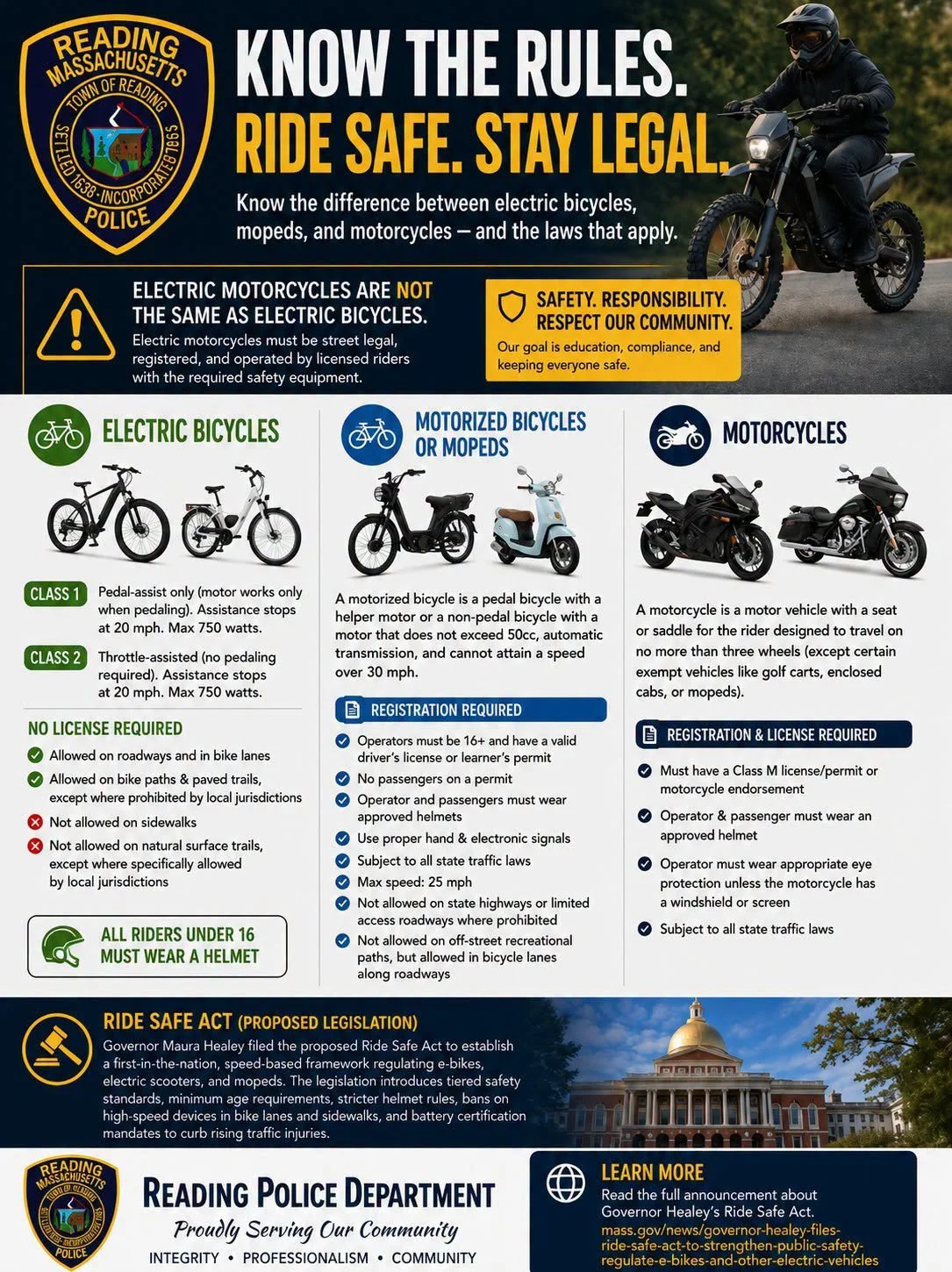
Graphic from the Reading Police Department Facebook page.
