(2-minute read)
The Massachusetts Department of Agricultural Resources is asking residents to be on the lookout for the spotted lanternfly, an invasive insect that has now been confirmed in several parts of the state. Midsummer is when the pest becomes easiest to spot, as late-stage nymphs give way to winged adults that remain active into December.
The insect does not bite or sting, and it poses no danger to people or pets. The concern is what it does to plants. Spotted lanternflies feed in large numbers on trees and crops, and in summer and fall they leave behind a sticky waste product called honeydew that encourages sooty mold. Vineyards, fruit crops, maples, and tree-of-heaven are among the plants most often affected.
Learning to identify it
The insect changes appearance considerably as it grows, which is part of what makes it easy to overlook. Egg masses, present from September through June, look like smears of putty or dried mud on bark, stone, and outdoor equipment. Early nymphs, seen from April into July, are black with white spots. Late nymphs, active from July into September, turn a striking red with white spots and black markings. Adults, which emerge in July and remain through December, are roughly an inch long with gray, spotted forewings and bright red hindwings that show in flight.
MDAR maintains identification photos for each life stage on the Mass.gov website.
What to do if you find one
Residents who encounter a spotted lanternfly are asked to take three steps:
Destroy it. Eliminating individual insects helps slow the spread of the species.
Photograph it. A clear photo allows state entomologists to confirm the identification.
Report it. Sightings in areas without a known infestation can be submitted on the Mass NRC website, and reports from residents remain one of the primary ways new populations are detected.
Additional guidance on identification, reporting, and management is available on the MDAR website, or by calling MDAR at 617-626-1779.
Why it matters locally
Reading’s tree canopy, private landscapes, and conservation areas all fall within the range of plants the insect will feed on. Early detection gives the state its best chance of limiting how far and how fast the population spreads, and that detection depends largely on residents noticing something unusual on a tree in their own yard and saying something about it.
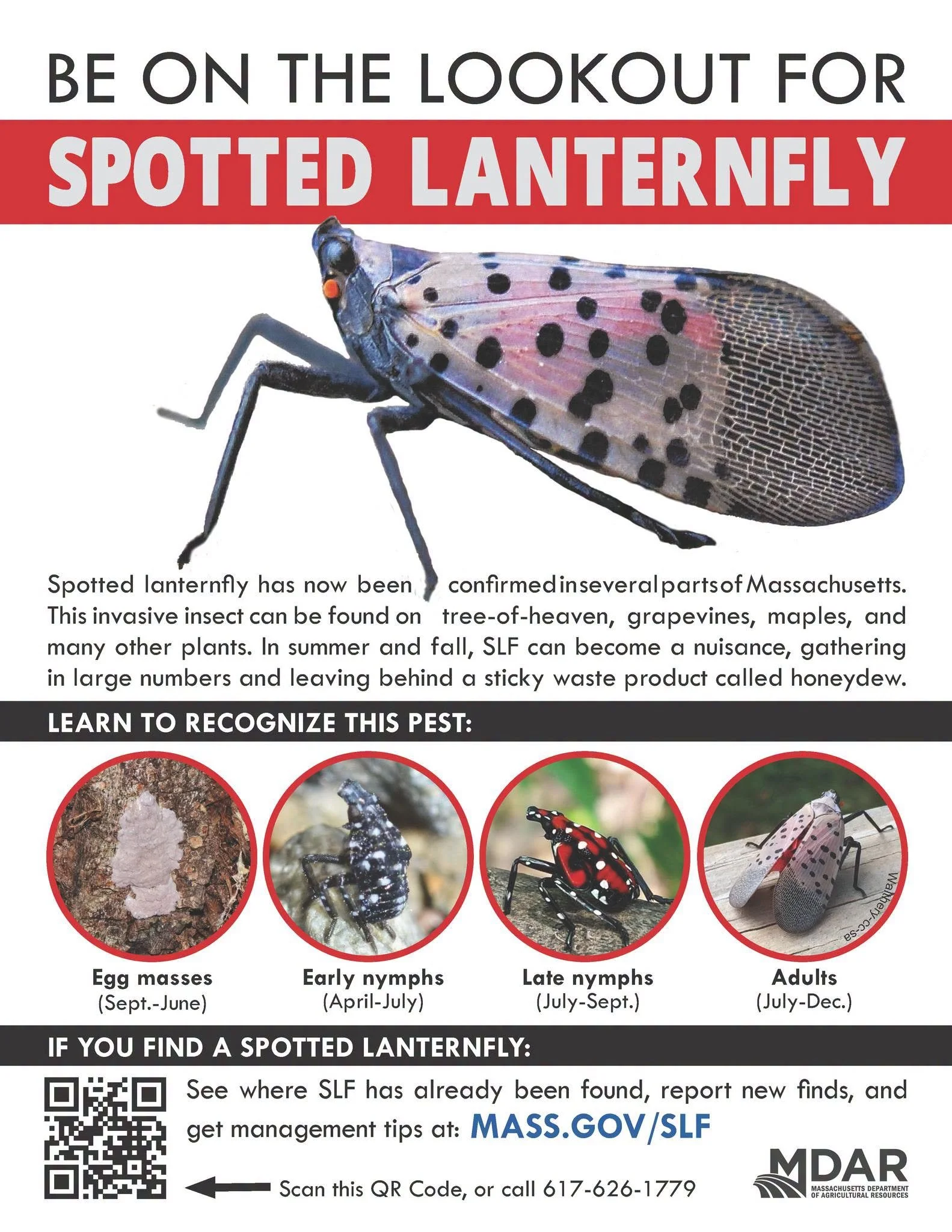
Flyer by the Massachusetts Department of Agricultural Resources.
