(11-minute read)
For residents looking to stay up to date on key town matters, this recap highlights the major takeaways from the joint Select Board, School Committee, and Finance Committee meeting held on Thursday, June 25, 2026.
Watch the full meeting here on RCTV’s Youtube page.
Review the full Joint Financial Forum packet.
Key takeaways
Town Manager Jayne Wellman presented an override range of $7.5M to $12M, with each amount carrying a different reliance on Free Cash and a different projected lifespan.
Officials outlined what a failed override would mean, including cuts to the library and ReCAL hours, police overtime, recycling frequency, rodent mitigation, and staffing, with roughly $6M in cuts equating to about 60 positions.
With an August 5 deadline to send ballot language to the state, board and committee members split over whether the November timeline allows enough public engagement.
Three override scenarios
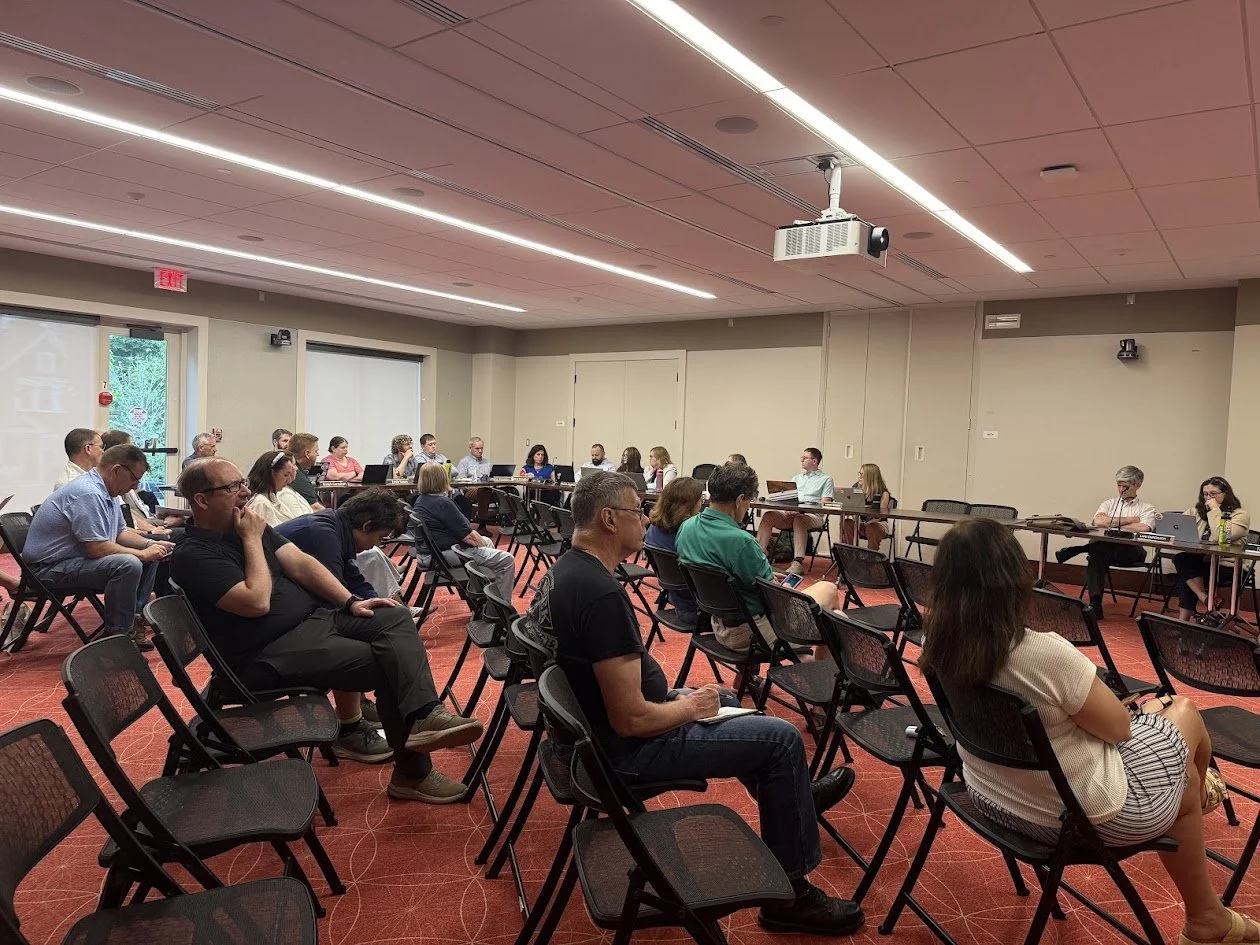
Members of the Finance Committee, Select Board, and School Committee gather with residents for the Joint Financial Forum on June 25, where officials laid out override options. Photo by Taylor Gregory.
Town Manager Jayne Wellman explained that department heads had built budgets at multiple service levels, and that the proposed override range runs from $7.5M to $12M. At $7.5M, the town would supplement with $2.5M of Free Cash to fund the Level 2 budget, a 3.75% increase. At $10M, no supplemental Free Cash would be needed in the first year. At $12M, Free Cash use would be pushed out further still, extending how long the override holds.
Chief Financial Officer Sharon Angstrom described Level 1 as the ideal-world budget and Level 2 as what the town is actually aiming for, with no expectation of adding items back in through an override. Wellman explained that Level 1 represents a 13% increase over FY27, cut down to a 3.75% increase under Level 2, and that Level 2 eliminates weekly recycling from the outset in FY28 because the town cannot afford it.
Wellman pointed to the cost drivers behind the gap: decades of decreasing unrestricted government aid, rising healthcare costs, inflation, software expenditures, and insurance policies. On the other side of the ledger, the town had renegotiated health insurance and property and casualty insurance, left some positions unfilled, and cut office supplies by 10%. Pensions will be fully funded by FY32, freeing an estimated $3M for operational expenses.
Angstrom noted the town was able to save in FY27 because a totaled cruiser was covered by insurance, but that Reading Police Department overtime remains a problem, with roughly $200,000 needed to bring it in line with recent years. Any community priorities identified would have to come out of the budget. If the override fails, the only additions to the budget would be what the new Killam and Reading Center for Active Living (ReCAL) buildings require, such as cleaning. School Committee Chair Shawn Brandt asked whether figures were annual, given that Killam will not be in place for the full year; Angstrom said staff planned for a full year of heating and staffing.
Wellman added that if Reading Public Library hours are cut, ReCAL hours will be cut as well. A department head had requested a full-time position to serve ReCAL, following months of conversation about the need for adaptive sports, though part-time positions could be funded through the recreation revolving fund. Those would be eliminated without an override.
Free Cash, the bond rating, and what a failed override costs
Much of the discussion turned on Free Cash and the town’s AAA bond rating. Angstrom explained that using the full amount of Free Cash would drop reserves below the 7% threshold and put that rating at risk. A $2M use of Free Cash equates to roughly a 4% reduction in the budget, while $6M in cuts equates to about 60 people, at roughly $100,000 per position, $85,000 in salary and $15,000 in benefits.
Select Board member Karen Herrick asked Angstrom to repeat the numbers and to compare Reading’s position to Wakefield, which dropped to an AA+ bond rating. Angstrom said the town would regenerate about $3M in Free Cash against a larger draw in FY28 and would fall below the 7% minimum reserve level. A downgrade would cost an estimated $1M to $1.5M in interest over the life of the loan, and ratings are far easier to lose than to regain. Angstrom said the town used a little over $6M in Free Cash in FY26.
Wellman said that under a $10M override, the town would not need supplemental Free Cash to balance the first year but would need it afterward, while a $12M override would hold off that need for several years, with the override projected to last through FY32. Forecasts assume a 3% operating budget, under which Free Cash could reach $14.55M by FY32.
Finance Committee member Ed Ross asked whether the town could combine an $8M override with $2M in Free Cash to extend the runway, and whether more Free Cash could be used to soften the FY27 cuts in a no-override scenario. Angstrom said it was possible but noted the staffing for new buildings is budgeted for a full year and that she did not want to break internal policies without Finance Committee discussion.
Angstrom laid out what happens if the override fails: the town would need a strategic plan built around a target number, which in turn set the number of staff reductions required. Wellman described the no-override consequences as requiring millions more in cuts not yet identified, along with thoughtful consolidation. Residents and businesses would feel it through reduced programming, capital expenditures, community engagement, library hours, ReCAL hours, trainings, rodent mitigation, and public works activities, plus hiring freezes and layoffs.
Taxpayer impact and competing costs
Several members pressed on how the override lands on an actual tax bill. Finance Committee member Endri Kume cited the average tax bill of $10,348 and said residents need to know specifically what they stand to lose, pointing to public safety and health first, including police overtime, crossing guards, safety details, and rodent mitigation, then sanitation and public works, and library hours, noting Sunday hours are a weekly ritual for many families.
Finance Committee Vice Chair Marianne McLaughlin-Downing raised that the override is not the only increase voters face, with Killam and ReCAL adding roughly $800 a year on top, and said the town needs to be clear about the impacts. Regardless of the scenario, the town takes on ReCAL’s costs, with a no-override outcome meaning fewer ReCAL hours. Downing said she would not support laying off school staff to hire for ReCAL, adding that the choice should not be between seniors and schools.
Wellman said the town’s tax calculator will be updated so residents can see when impacts hit based on their own valuations. She also reported that Killam bids came in well below projections, with a construction budget forecast at $101M coming in at $75M. Angstrom said that changes cash flow and could push back the timing of borrowing, with short-term borrowing possible to avoid over-borrowing, and that the town would look to delay the second tranche of debt to FY29 so it does not land at the same time as an override.
Finance Committee member Mark Zarrow asked about the Pleasant Street facility and whether it holds revenue potential. Wellman said a study is underway, with options including retaining the building at a cost, selling it, redeveloping it with a third party for housing, or transferring it to a commercial enterprise or nonprofit. Projected future maintenance runs $2.1M to $4.1M, with a middle estimate around $3.1M, against roughly $70,000 in annual maintenance now. Community feedback has favored retaining it, with a preference for the Reading Food Pantry or a nonprofit. Wellman wants a decision by the fall to bring to Town Meeting so a buyer or lessee has runway before the town vacates for ReCAL.
Asked about new growth, Wellman pointed to the ongoing Eastern Gateway work and MassDOT’s acceptance of the Walkers Brook project into the TIP for federal funding. Herrick noted the Select Board has been issuing new business permits, with two new restaurants open and two more coming. On rodent mitigation, Wellman said the current program runs about $50,000 for 50 traps per day and would have to be reduced, with a carry-in carry-out trash policy saving little.
Next steps and the timeline question
Wellman asked what the bodies needed before July, with the next Select Board meeting set for July 9. Finance Committee Chair Joe Carnahan turned the question around, noting the board had not asked them to decide anything, that putting an override on the ballot is the Select Board’s responsibility, and that the Finance Committee can make recommendations. He suggested the Finance Committee could weigh in on how the town uses Free Cash.
Wellman said what she needs from the Finance Committee is its appetite for a first-year Free Cash figure. Angstrom said she supports maintaining the town’s discipline of funding 5% of the capital budget, and would back Free Cash use for capital expenditures. Ross agreed, saying that discipline is what sets Reading apart from other communities.
On the number itself, Finance Committee member Joe McDonaugh said he wants to find the sweet spot, keeping the AAA bond rating without asking taxpayers for more than necessary, suggesting a modest Free Cash draw with a $7.5M to $8M override. Kume called the timing terrible given the debt from two buildings but said the structural override is unavoidable, favoring $7.5M. Angstrom noted stabilization funds are part of the reserves that support the bond rating and that the town tends to avoid them when Free Cash is available.
Select Board Chair Melissa Murphy thanked town staff and urged caution about adding items back in, saying the town needs to present what taxpayers stand to lose rather than what could be gained. With two buildings, a Community Preservation Act (CPA) question, and an override all in front of voters, she said, spending on nice-to-haves would look greedy, and being clear about the consequences of failure is what made the difference last time. Murphy expressed her preference for a single override question. Brandt agreed, but said a tiered vote is not precluded.
School Committee member Erin Gaffen said she understood Murphy’s point but that the framing has to be crystal clear, noting the Fire Department did not add five new staff, but rather filled vacancies, and that weekly recycling is a need or a nice-to-have depending on the household. She favored a tiered approach paired with clarity about what is lost regardless and how long the override lasts, adding that she does not believe residents have the appetite for frequent overrides and that the conversation is about cutting less, not adding more.
Select Board member Chris Haley said it is not fair to rush the process and put the Select Board in a difficult position, and said the matter has not been hashed out enough without more public input. He said he was uncomfortable voting in two weeks, that rushing it would cause it to fail, and that he believes it will fail regardless, raising the possibility of trying again before April.
Wellman said the deadline is August 5 for the November ballot, and that a separate special election would cost about $20,000. She noted many communities put forward one number and turn to multiple questions only if it fails, pointing to Arlington, Melrose, and Stoneham as recent examples. She said she liked the idea of a later Select Board meeting for more runway and could bring material to the Finance Committee the week of July 13.
Carnahan recommended settling on a minimum override number with an implied Free Cash use, and asked for a recommendation on how many tiers to use and what is preserved at the higher tiers. Kume asked for a single table showing the amount and the tax impact per resident, how many years it would last, and what the public is promised. Resident John Arena said time is short and that planning and the rationale need to be developed in tandem, urged keeping the message simple for an audience not swimming in this information, and noted that changes need to be framed relative to the FY28 tax bill with the debt exclusions included. He recalled the 2018 override as painful.
Haley asked how things change as RISE moves to Killam in terms of positions and space. Wellman said the School Department’s FY28 plan includes no added positions and 3% increases. Brandt said no decisions have been made but that innovation pathways could benefit from additional space at no added cost, along with the potential to bring more special education programming in district, including a specialized program for deaf and hard-of-hearing students that generates revenue.
Who decides what
The Select Board sets both the amount and the timing of an override question, and is the only authority in town that can place one on the ballot. The board makes that decision in consultation with the School Committee and the Finance Committee so the town’s elected leaders are working together on the path forward.
The Finance Committee first discussed the need for an override at the October 8, 2025, Financial Forum to address the growing structural deficit. Haley, who chaired the Select Board from April 2025 through April 2026 and was responsible for setting the board’s agenda during that period, said at this meeting that the process to gather the necessary information ahead of the August 5 state deadline felt rushed and had not allowed sufficient time for public input.
Watch the June 25, 2026 Joint financial Forum with the Select Board, Finance Committee, and School Committee on the RCTV Youtube page.
