Select Board recap: July 14, 2026
(8-minute read)
For residents looking to stay up to date on key town matters, this recap highlights major takeaways from the Select Board meeting held on Tuesday, July 14, 2026.
Watch the full meeting here on RCTV’s Youtube page.
Review the full Select Board packet.
Key takeaways
The Select Board and Board of Library Trustees held a joint meeting and appointed Brenna Sullivan to fill a vacancy on the Board of Library Trustees.
Zoll Medical Corporation recognized the Reading Fire Department as one of just 20 organizations honored worldwide for its cardiac care.
Police Chief David Clark announced he will retire in May 2027 and recommended Deputy Chief Christine Amendola as his successor.
The Select Board discussed a wide range of options for structuring a proposed override for the ballot.
New library trustee appointed [0:02:05]
The Board of Library Trustees joined the Select Board to fill a vacancy, with Trustees Chair Cappy Popp, Vice Chair Monette Verrier, Andrew Gregory, Pat Egan, and Kelli Bacon taking part in the interviews. Two candidates made their case: Jason Clarke and Brenna Sullivan.
Clarke told the boards he has lived in Reading since 2012, serves as a Town Meeting Member, and spent eight years on the Bylaw Committee. He has worked in libraries since his undergraduate days in the 1990s and is currently on staff at Harvard University’s library. While he primarily uses the Harvard collections himself, he notes his wife and daughter are avid users of the Reading Public Library.
Sullivan, a lifelong Reading resident, is 25 and works as a bookseller at Whitelam Books while nannying during the week. She said both roles keep her close to Reading families, whether she is helping them find their next read at the shop or spending time with kids in the school system, and she counts herself an avid library user as well.
Trustees asked both candidates about what they saw as the library’s most valuable resource, how they understood the role of a Trustee, what expertise they would bring to the board, and how they would have handled the book challenges Reading faced in 2023. The Select Board asked how each would approach the difficult budget years ahead with an override looming. After considering nominations for both, the boards appointed Sullivan by a vote of 5-0 from the Trustees and 5-0 from the Select Board.
Fire Department recognized for cardiac care [0:42:00]
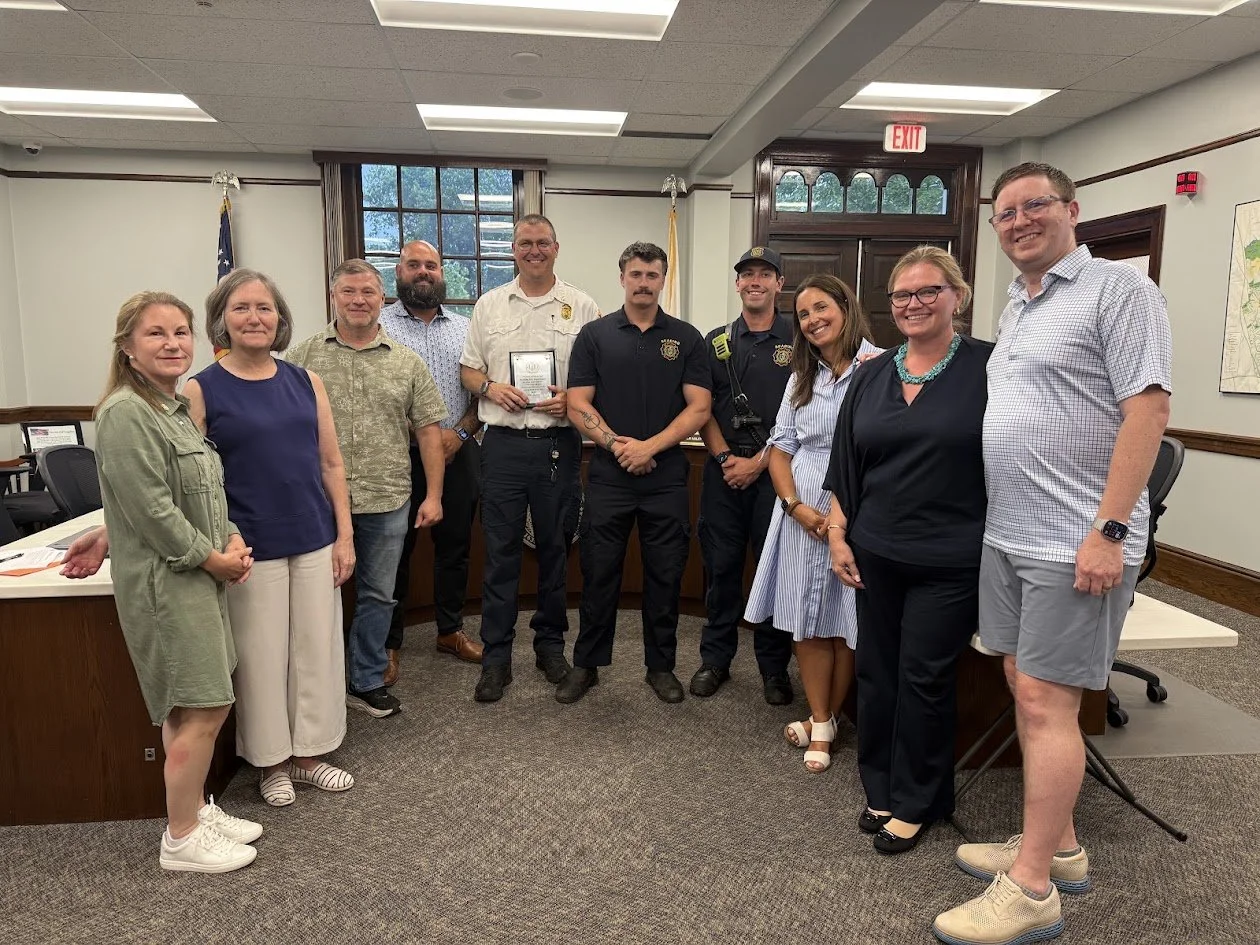
Reading Fire Department members accept recognition from Zoll Medical Corporation at Tuesday’s Select Board meeting. Pictures (left to right): Board members Karen Herrick, Vice Chair Karen Rose-Gillis, Sal Bramante, Corey Frerichs of Zoll Medical, Chief Rick Nelson, FF Doug Coutu, FF Ben Braz, Chair Melissa Murphy, Town Manager Jayne Wellman, and Chris Haley. Photo by Taylor Gregory.
Corey Frerichs of Zoll Medical Corporation recognized the Reading Fire Department for delivering advanced care early and improving patient outcomes. He called the department’s staff “second to none” and credited Chief Rick Nelson and Assistant Chief John Keough for the culture they have created. Reading is one of 20 organizations recognized globally, and Frerichs said he was grateful for the partnership and that other departments should aim to match Reading’s standard.
Two firefighters, Ben Braz and Doug Coutu, were recognized with save certificates and challenge coins for the first use of the Zenix machine in the field. Chief Nelson explained that the Zoll equipment is used to treat patients in cardiac arrest, giving responders a clearer picture of what is happening, recommending medications, and evaluating the rate and depth of mechanical chest compressions.
Police chief announces 2027 retirement [0:51:27]
Reading Police Chief David Clark announced that he will retire on May 10, 2027, after 32 years with the department. He called it a great honor to serve the community he grew up in and thanked those who supported him throughout his career and his appointment.
Clark, who became chief in 2018, pointed to the ways he worked to move the department forward, including diversifying the workforce and establishing a drone unit, mental health services, K-9 units, and comfort dogs, as well as strengthening social media and community presence. He notes that much of the work was funded through grants and seizure funds, limiting the cost to taxpayers.
Clark said the decision has been in the works for some time, including conversations with former Town Manager Matt Kraunelis, and that he was announcing it now so his successor could take part in budget discussions and help carry out decisions after his departure. He recommended appointing Deputy Chief Christine Amendola as the next chief, praising her service to the town, her performance on promotional exams, and her work on the Municipal Police Training Committee. He added that she will spend the next 3 weeks at a national chief training program at Boston University, and that ensuring continuity is part of his job. Board members, some caught by surprise, thanked Clark for his years of service.
Override discussion takes shape [1:22:45]
Town Manager Jayne Wellman opened the override discussion with an overview of the packet and laid out what she needed from the board: whether the override should appear as a single question, a tiered option, or a multi-year option. The three approaches break down as follows:
Single question. A single override is framed either around general purpose (funding the operating budgets of the town and public schools for the fiscal year) or general categories (funding local and regional schools, public safety, library, highway, parks and recreation, and general government expenses).
Tiered question. Two or more funding levels appear as separate ballot questions. If voters approve more than one, the question with the highest dollar amount prevails, and the levy limit increases by that amount. Melrose, Marblehead, and Stoneham have recently used this approach.
Multi-year question. Two or more questions apply to different fiscal years. Voters could, for example, approve a $10M override borrowed as $4M in year 1, $3M in year 2, and $4M in year 3.
Several board members favored a single question, arguing that simple, clear communication and steady, predictable increases would serve residents better than large fluctuations. Chris Haley said he would not support any override option unless it appeared on the April 2027 ballot rather than the November 2026 ballot, saying the process felt rushed and that due diligence was needed to give an override the best chance of passing in the spring.
Wellman noted that an override on the later ballot would require town staff to prepare two full budgets in case the override failed, while a November vote would allow staff to prepare a single budget for the April 2027 Town Meeting. She later added that the tiered approach gives residents more choice and feels more empowering to neighbors. As chair of the Select Board, a role he held from April 14, 2025, through April 14, 2026, Haley was responsible for setting the board’s agenda. Over that time, the board did review the town’s financial position; discuss ways to raise revenue through field advertising, short term rentals, and acessory dwelling unit rules; update building permit and fire department fees; and discuss a downtown valet parking policy that ran counter to the Reading Police Department’s recommendation, detailed in a memo from the police chief on page 5 of the September 16, 2025, packet. The board’s earlier review did not advance to an override plan despite there being clear indications that one would be needed soon, and Haley now says the current timeline feels rushed.
Wellman also proposed that the Finance Committee revisit the town’s policies on using Free Cash to supplement the budget. Reading has drawn state recognition for funding capital investments with 5% of the annual budget at the April Town Meeting, rather than appropriating it in the fall after free cash is certified. She suggested tying the amount drawn from Free Cash to capital investment and trimming the capital budget proportionally so the two align, with the option to defer some purchases, such as an ambulance or equipment, to future years. Once an override amount is chosen, she said, the town will update its tax calculator so residents can see the impact on their household, including the effect of the Community Preservation Act (CPA).
Wellman noted that the minimum override needed for FY27 would be $6.5M, but that figure would only carry the town for a year or two, while a larger override would reduce the reliance on Free Cash for several years. Chief Financial Officer Sharon Angstrom clarified how the borrowing for the Killam and Reading Center for Active Living (ReCAL) projects factor into tax bills under an override. The town borrowed the first tranche of $70M total, $50M for Killam and $20M for ReCAL, to manage cash flow through June 2027. More than half the expected amount for each project has been borrowed, with the second tranche not anticipated until FY29. Both projects are coming in under budget, which reduces how much will need to be borrowed later without over-borrowing now.
Karen Herrick asked whether CPA could be moved to the April 2027 ballot to avoid wasting the work of the volunteers who brought it to Town Meeting. Town Clerk Laura Gemme explained that it has to appear on the November ballot, since that is what the April 2026 Town Meeting approved. Wellman also gave an update on the pickleball project, noting that $225,000 in donations from the Reading Pickleball Players Association, $200,000 from the Burbank Ice Arena Fund, $100,000 from Capital, and $100,000 from a PARC grant meant $625,000 would not be borrowed, on top of the project coming in under budget.
More signage for elections [2:18:25]
Town Clerk Laura Gemme asked the town to purchase signage to alert residents to upcoming elections, citing Wakefield as a model. The plan would add magnets listing the election date to permanent signage mounted on existing traffic signs. Gemme said she would work with the police department to identify the best intersections and with DPW to update the dates as needed, anticipating roughly 20 signs around town. Vice Chair Karen Rose-Gillis asked how long Wakefield has used its signs. Gemme was not certain but said she would consult the Wakefield Town Clerk for suggestions, adding that Wakefield’s signs have been in place for at least the 17 years she has lived in Reading.
Watch the June 23, 2026 Select Board meeting on the RCTV Youtube page. Seated (left to right): town staff Maddie Baptiste, BoLT members Andrew Gregory, Vice Chair Monette Verrier, Chair Cappy Popp, Select Board members Karen Herrick, Vice Chair Karen Rose-Gillis, Chair Melissa Murphy, Chris Haley, Sal Bramante, and Town Manager Jayne Wellman.
