Superintendent interview recap: March 31, 2026
(5-7 minute read)
For residents following the future leadership of Reading Public Schools, the School Committee held a public interview with superintendent finalist, Dr. Henry Turner, at Reading Memorial High School on Tuesday, March 31, 2026.
Watch the full meeting here on RCTV’s Youtube page.
Review the full School Committee packet.
Review our coverage of the School Committee’s vote to appoint Dr. Turner on April 4.
Key takeaways
Turner emphasized strong alignment with Reading’s values of inclusion, academic excellence, and support for all students.
He acknowledged significant budget challenges ahead, stressing the importance of prioritization and community trust.
His experience leading large, complex schools informed much of his approach to equity, instruction, and systems-level improvement.
Interview overview [0:11:27]
School Committee Chair Shawn Brandt opened by underscoring the significance of the superintendent role, describing it as one of their most important responsibilities, alongside setting district policy and stewarding the schools. While Turner was the sole finalist interviewed, Brandt made clear the Committee is not obligated to make a selection and will determine whether he is the right fit for Reading.
Turner, currently principal of Newton North High School, introduced himself as a leader grounded in both personal and professional experience. Growing up in Melrose, he described Reading as an “aspirational” community and noted that the district’s values, particularly around inclusion and diversity, closely align with his own. He pointed to his longstanding connection to METCO programs and his motivation to support all students, including those with disabilities, as central to his work in education.
Leadership philosophy and district alignment [0:18:49]
Throughout the interview, Turner framed his leadership approach around building systems that support student success over time. Drawing on his experience at Newton North and Bedford high schools, he described a focus on creating structures that allow districts to make steady, measurable gains rather than relying on quick fixes.
A major part of that work has involved expanding access to high-level coursework. Turner discussed efforts to address disparities in honors and Advanced Placement enrollment, particularly among students of color, low-income students, and students with disabilities. By rethinking placement practices and grading systems, he said his teams increased participation and improved outcomes for a broader range of students.
He also pointed to improved post-secondary outcomes as a measure of success, including a significant increase in students gaining admission to preferred colleges, as well as strong participation in programs like biliteracy certification and first-generation college support initiatives.
Budget realities and decision making [0:23:38]
With Reading facing potential financial challenges, including the possibility of an operational override, budget questions were a central focus of the interview. Turner acknowledged that these pressures are not unique and shared his experience managing cuts, including making rapid reductions at Newton North.
Rather than offering a single solution, he emphasized a process-driven approach. That includes working closely with the School Committee and community to identify priorities, maintaining transparency about tradeoffs, and building long-term plans that reflect community values. He also highlighted the importance of communicating the value of public education to residents, including those without school-aged children, to build broader support for funding decisions.
Responding to community issues and national events [0:27:26]
Turner described the superintendent role as extending beyond academics, particularly when responding to national or global events that impact students and families. He emphasized the importance of creating school environments where students feel supported and heard, while also encouraging respectful dialogue across differing viewpoints.
He shared examples from his current role, including opportunities for families to come together following major international events. In those moments, he said the goal is not to resolve complex global issues, but to ensure students feel safe, supported, and able to process what they are experiencing.
Approach to conflict and complex scenarios [0:47:56]
In responding to a detailed hypothetical scenario involving a parent complaint, social media escalation, and potential residency concerns, Turner outlined a methodical and people-centered approach. He emphasized the importance of lowering tensions, gathering accurate information, and ensuring that students are receiving appropriate services.
His response focused on several key steps:
Confirming whether the student’s needs are being met and documentation is accurate
Communication with school leadership and central administration
Consulting legal guidance where necessary
Listening directly to the family to understand concerns
Support staff while ensuring accountability and adherence to policy
He also stressed the importance of clear communication with the School Committee, noting that while members may receive information from the public, formal responses and investigations should be coordinated through the Superintendent’s office.
Instruction, equity, and student outcomes [1:00:29]
A consistent theme throughout the interview was Turner’s focus on instructional improvement and equity. He described efforts to shift grading practices toward measuring learning rather than behavior, as well as expanding opportunities for students to engage in rigorous coursework.
At the same time, he acknowledged ongoing challenges facing schools, including:
Lingering impacts of COVID-19 on literacy
Increasing mental health needs among students
Chronic absenteeism
The need to balance academic and interpersonal skill development
He also raised questions about how professional development is structured and evaluated, emphasizing the importance of aligning training with district goals and ensuring that it translates into improved student outcomes.
Working with the School Committee [1:09:38]
Turner described the relationship between the superintendent and School Committee as a collaborative partnership built on communication and trust. He suggested establishing shared expectations early, potentially through a retreat, and maintaining regular updates so members feel informed and prepared to respond to community concerns.
He emphasized that, especially in smaller communities, issues can rapidly become widely discussed, making proactive communication essential.
Special education and inclusion [1:16:03]
Turner acknowledged that special education would be an area for continued growth in this leadership, while also expressing strong support for Reading’s current programming. He noted that during his visit, he was impressed by the district’s ability to provide in-district services for a wide range of student needs.
He emphasized the importance of regularly reviewing programs to identify strengths and gaps, ensuring consistent definitions of inclusion across schools, and maintaining a focus on student outcomes. He also highlighted the financial implications of out-of-district placements and the need to balance cost with quality and compliance.
Closing remarks [1:27:22]
In his closing statement, Turner thanked the School Committee and community for what he described as a thorough and thoughtful process. He noted the level of stakeholder engagement, including educators, families, and community groups, as a reflection of Reading’s strong commitment to its schools.
He said the community’s passion, expectations, and track record of success made the role particularly appealing, adding that he would be honored to serve as superintendent if selected.
The School Committee continued its deliberations on Saturday, April 4, as it considers next steps in the superintendent selection process.
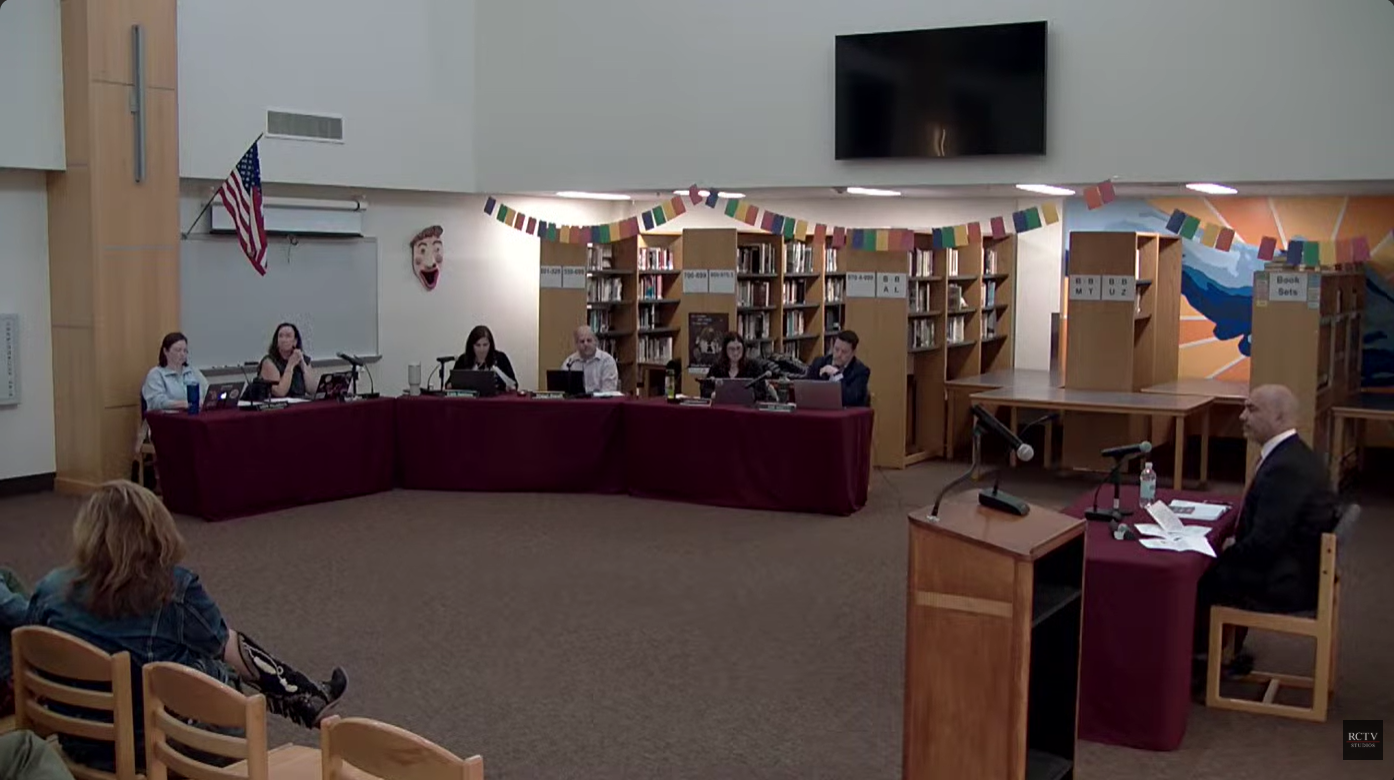
Image of the March 31, 2026 School Committee meeting from the RCTV Youtube page. Pictured (left to right): Committee members Sarah McLaughlin, Erin Gaffen, Carla Nazzaro, Chair Shawn Brandt, Lara Durgavich, Tom Wise, and Dr. Henry Turner.
