Why “Lift Every Voice and Sing” matters: the story and significance of the Black National Anthem
(7-9 minute read)
A recent issue of the 28 Days of Black History newsletter from Feb. 8, 2026, highlights the history and lasting impact of “Lift Every Voice and Sing,” widely known as the Black National Anthem. More than a song, it is a cultural touchstone - one that connects education, faith, protest, and perseverance across more than a century of U.S. history.
The project behind the newsletter, available at 28DaysOfBlackHistory.com, publishes daily stories in February that center Black history, voices, and contributions, with an archive of past editions available for continued learning.
A song born in a segregated school
“Lift Every Voice and Sing” was first performed on February 12, 1900, by 500 children at the segregated Stanton School in Jacksonville, Florida. The lyrics were written by educator and writer James Weldon Johnson, and the music was composed by his brother, John Rosamond Johnson, a classically trained musician.
The piece was originally created for a school celebration honoring Abraham Lincoln’s birthday. What began as a one-time performance spread organically as students carried the song with them to other schools and communities. Teachers taught it, churches sang it, and within two decades, it was widely known across the South and beyond.
In 1919, the National Association for the Advancement of Colored People (NAACP) adopted the song as its official anthem. Over time, it came to be widely recognized as the Black National Anthem - not as a replacement for the U.S. national anthem, but as a parallel cultural and historical expression of Black identity, struggle, faith, and hope.
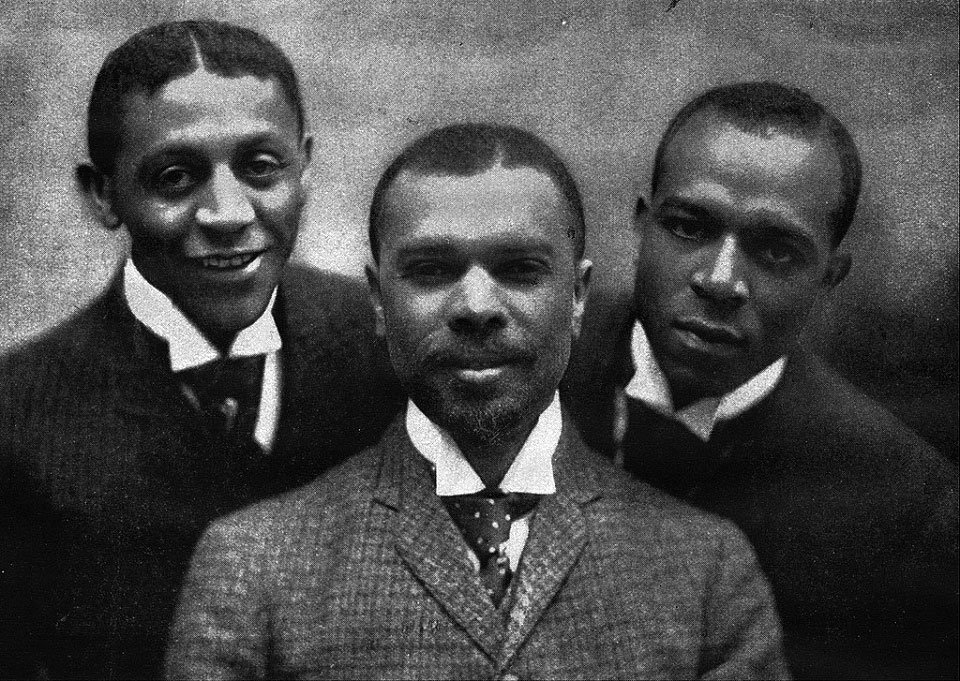
A black and white portrait of composers and producer Bob Cole, James Weldon Johnson, and J. Rosamond Johnson (from left) from Jan. 1, 1900. Image Source: Schomburg Center for Research in Black Culture, Photographs and Prints Division, New York Public Library.
Why the Black National Anthem is important
The power of “Lift Every Voice and Sing” lies not only in its melody but in its structure and message.
The verses move through three emotional stages:
Celebration and hope - calling people to raise their voices together
Memory and truth - acknowledging suffering, injustice, and sacrifice
Commitment and faith - expressing determination, spiritual grounding, and perseverance
It is both a remembrance and a declaration, recognizing painful history while affirming dignity and forward movement. During the Civil Rights Movement, the song was sung at marches, mass meetings, and church gatherings, linking generations of activism.
The anthem remains common at historically Black colleges and universities, cultural events, faith services, and major public gatherings. Artists across genres, from gospel to R&B to pop, have recorded it, and performances continue to introduce it to new audiences.
Ongoing conversation and contemporary use
In recent years, performances of the Black National Anthem at major sporting and civic events have sparked renewed public conversation. Supporters view these moments as overdue recognition of a song that has long been embedded in U.S. civic and cultural life. Critics have sometimes misunderstood its role and history.
Members of Congress have even proposed recognizing it formally as a national hymn - intended to stand alongside existing national symbols, not replace them - underscoring its historic and cultural influence.
Watch the Howard Gospel Choir of Howard University sing “Lift Every Voice and Sing”.
About 28 Days of Black History Project
The 28 Days of Black History initiative publishes a daily newsletter in February that highlights overlooked stories, context, and figures in Black history. Its mission is educational: to expand public knowledge and encourage deeper engagement with Black historical narratives.
Readers can:
Explore additional stories and learning tools at 28DaysOfBlackHistory.com
Reflection: questions to consider
The newsletter encourages readers to reflect, not just read. Consider the following questions:
What other songs have spread organically through communities and become symbols of identity or justice?
How do schools - historically and today - help advance representation and equity?
What songs give you a sense of hope, belonging, or shared purpose?
Taking time to reflect helps transform history from information into understanding.
Learn more and listen
Black history is not only about the past - it is about how stories, songs, and symbols continue to shape civic identity and shared values today. Readers who want to go deeper can explore performances of Lift Every Voice and Sing, lyric interpretations, and historical features on the Stanton School, where the song was first performed. The 28 Days of Black History project also curates community singing moments and educational materials that bring the anthem’s legacy to life. Additional learning resources, along with the full archive of past newsletters, are available through the project’s website for those who want to continue exploring the history, meaning, and ongoing impact of this enduring song.
“Lift every voice and sing
Till earth and heaven ring,
Ring with the harmonies of Liberty;
Let our rejoicing rise
High as the listening skies,
Let it resound loud as the rolling sea.
Sing a song full of the faith that the dark past has taught us,
Sing a song full of the hope that the present has brought us.
Facing the rising sun of our new day begun,
Let us march on till victory is won.”
